Module microsoft.teams

ballerinax/microsoft.teams Ballerina library
Overview
Microsoft Teams is a proprietary business communication platform developed by Microsoft, offering workspace chat, video conferencing, file storage, and application integration.
The ballerinax/microsoft.teams connector allows you to programmatically access and manage Microsoft Teams resources through the Microsoft Graph API v1.0. It supports working with teams, channels (including the primary channel), channel members, messages and replies, hosted content, tabs, and teamwork tags.
Setup guide
To use the Microsoft Teams connector, you need access to a Microsoft 365 account and an application registered in Microsoft Entra ID.
Note: The screenshots in this guide are for illustration only. The Microsoft Entra admin center changes over time, so treat them as a visual reference rather than an exact match — follow the described actions and choose the values (application name, redirect URI, permissions, and so on) that fit your own scenario.
Step 1: Register an application in Microsoft Entra ID
-
Sign in to the Microsoft Entra admin center.
-
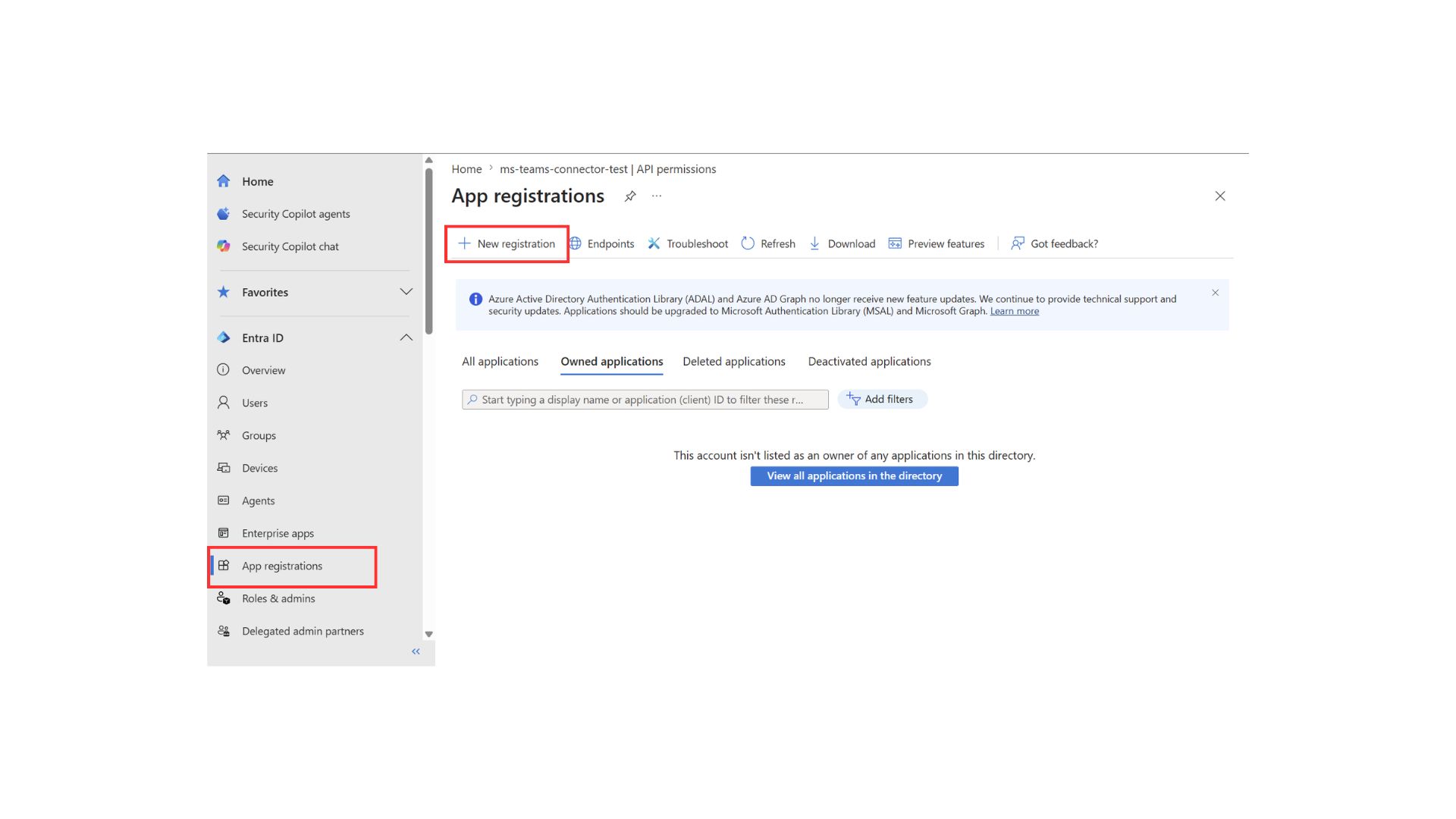
Navigate to Entra ID > App registrations and click New registration.
-
Enter a name of your choice and select the account types appropriate for your organization. For delegated (
refresh_token) access, add a Redirect URI under the Web platform — this is where the sign-in flow returns the authorization code (a Microsoft-hosted page such ashttps://jwt.msis a convenient choice for Step 4). The Web platform is required here because the connector redeems the code using a client secret (a confidential-client flow); the public "Mobile and desktop applications" platform does not accept a client secret. Click Register.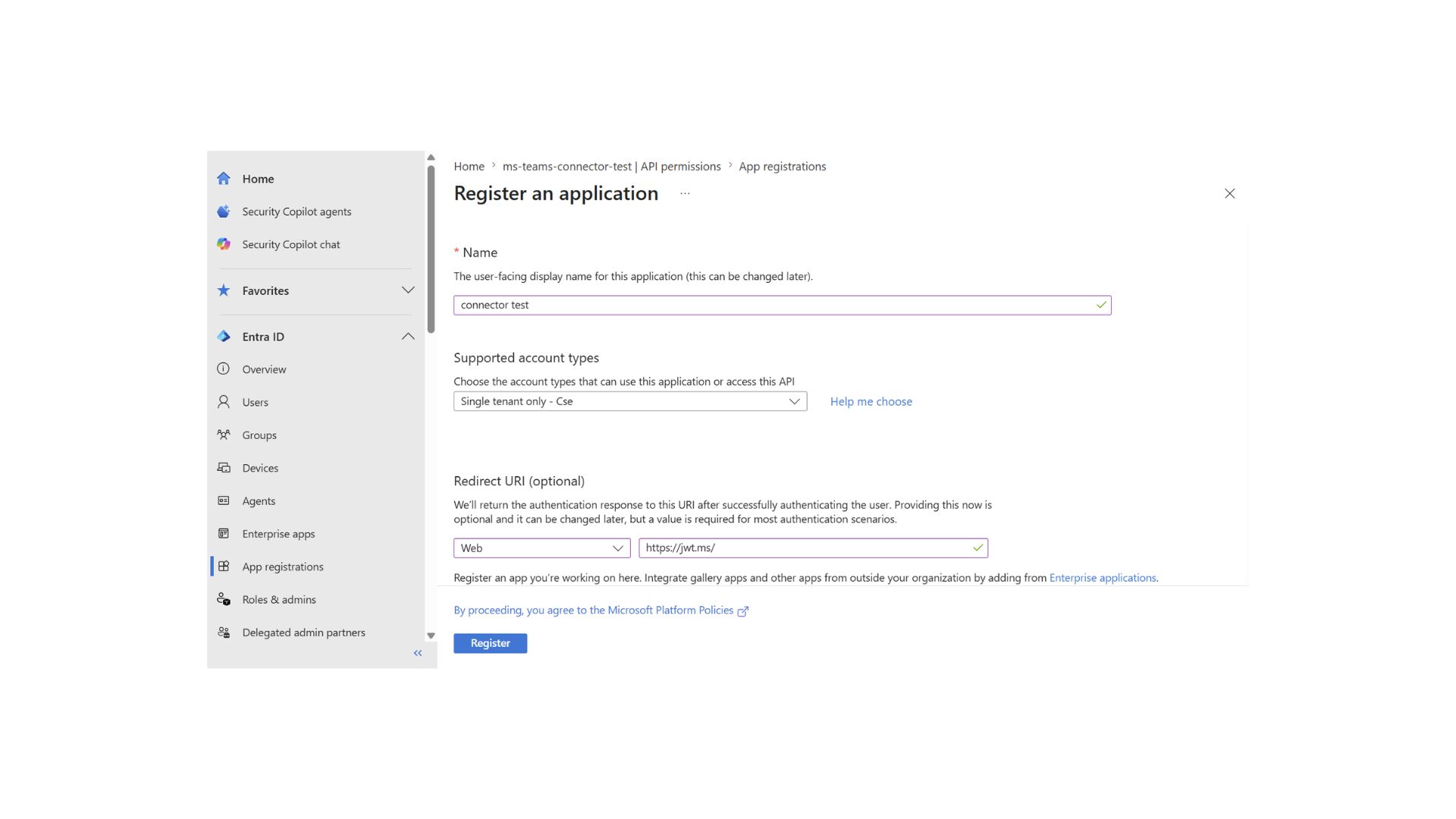
-
On the app's Overview page, note the Application (client) ID and Directory (tenant) ID — both are needed for
Config.toml.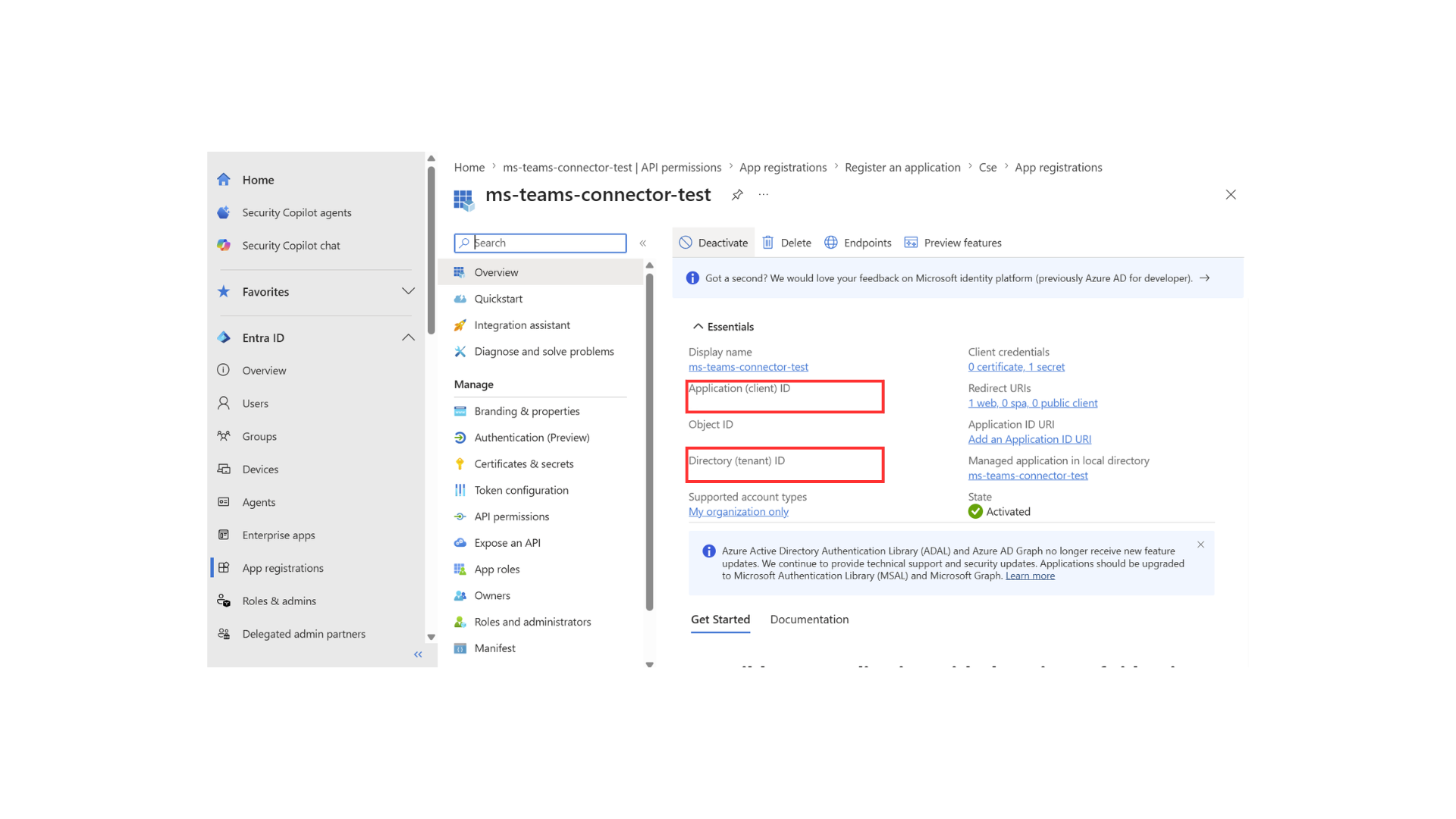
Step 2: Add Microsoft Graph permissions
-
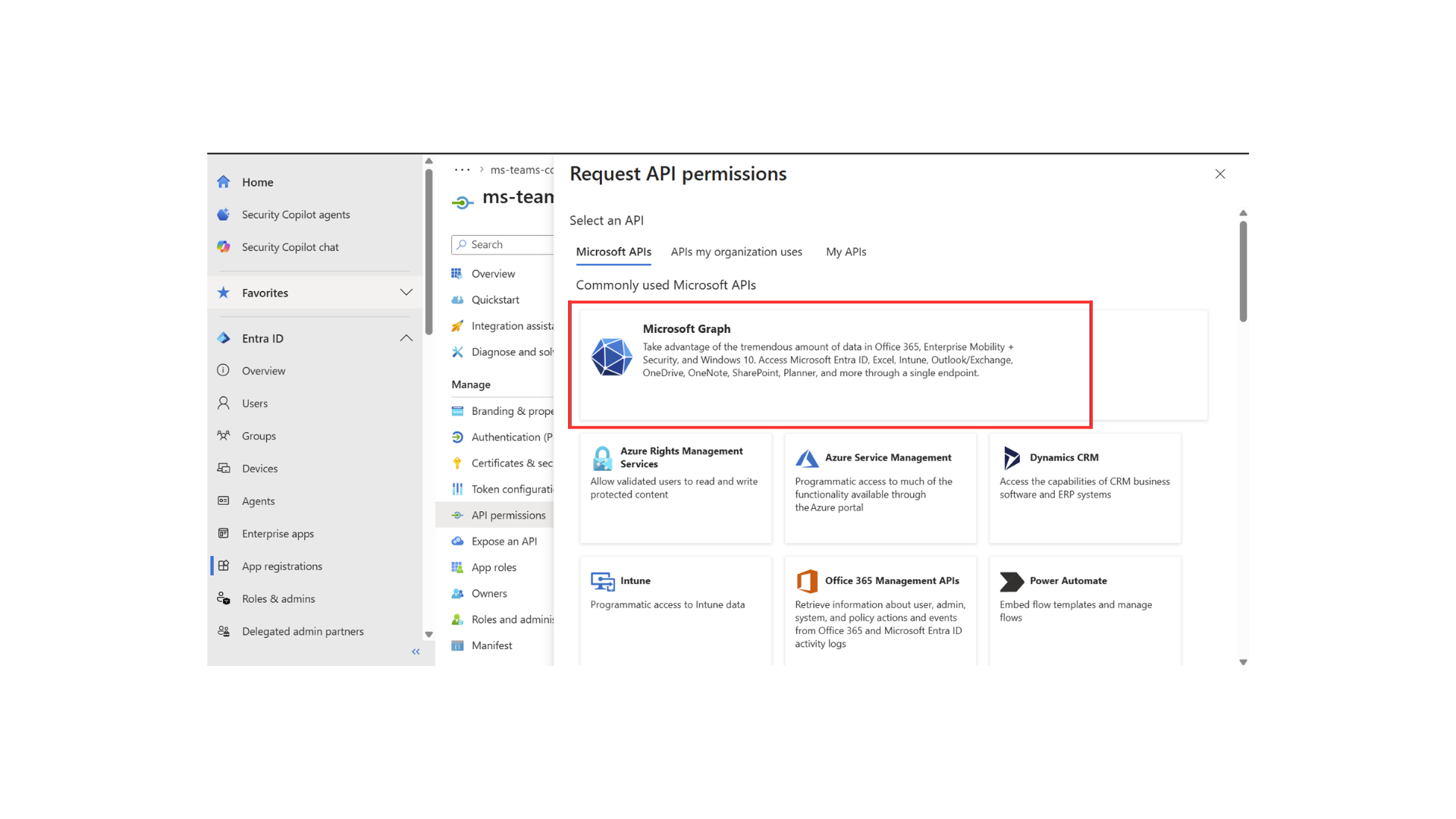
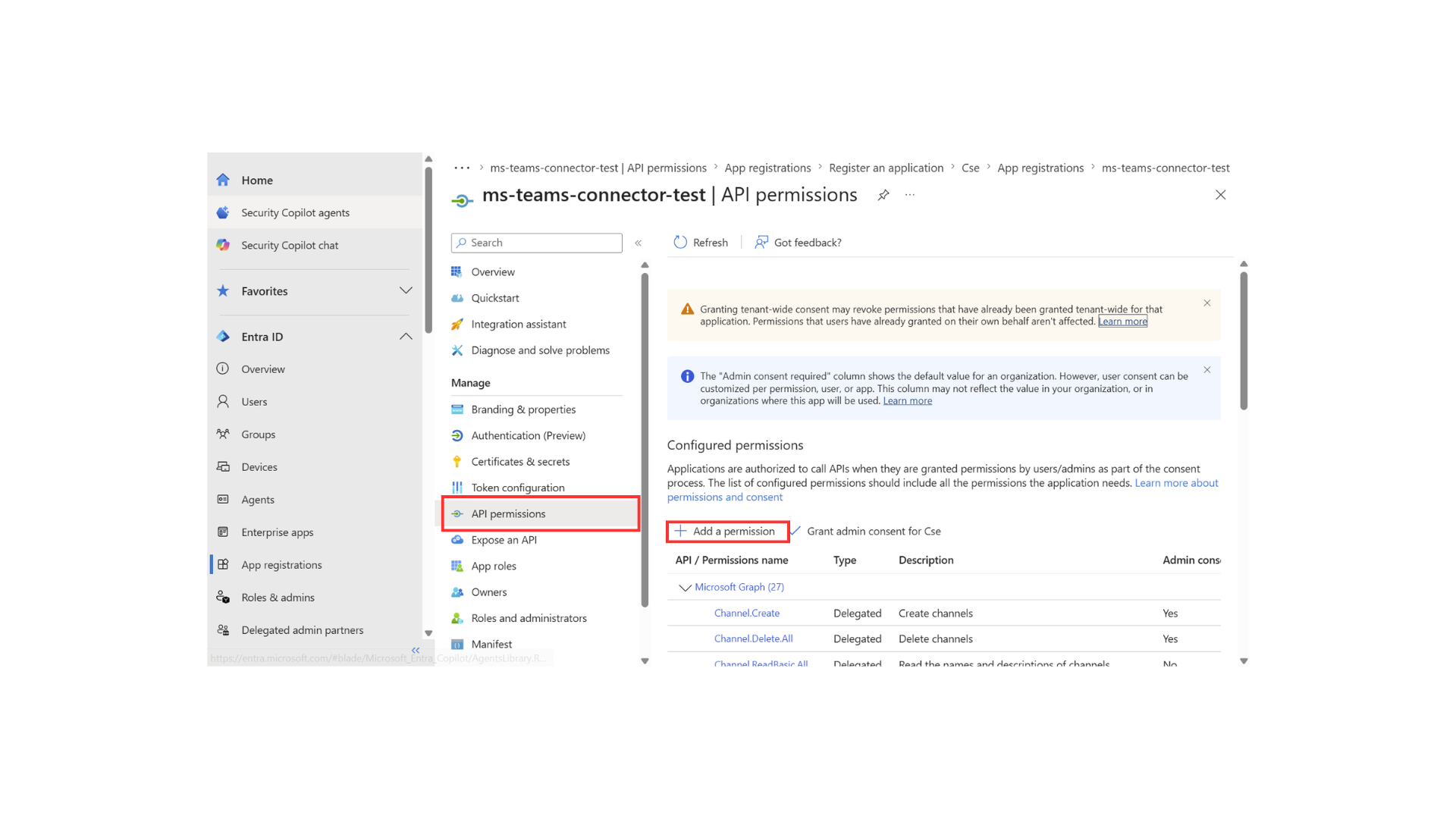
In the registered application, go to API permissions > Add a permission > Microsoft Graph.
-
Choose Delegated permissions (for
refresh_token) or Application permissions (forclient_credentials), then add the permissions your use case requires — each operation's required scope is listed in its Microsoft Graph API reference. For the delegated flow, also includeoffline_accessso the token response includes a refresh token. Click Add permissions.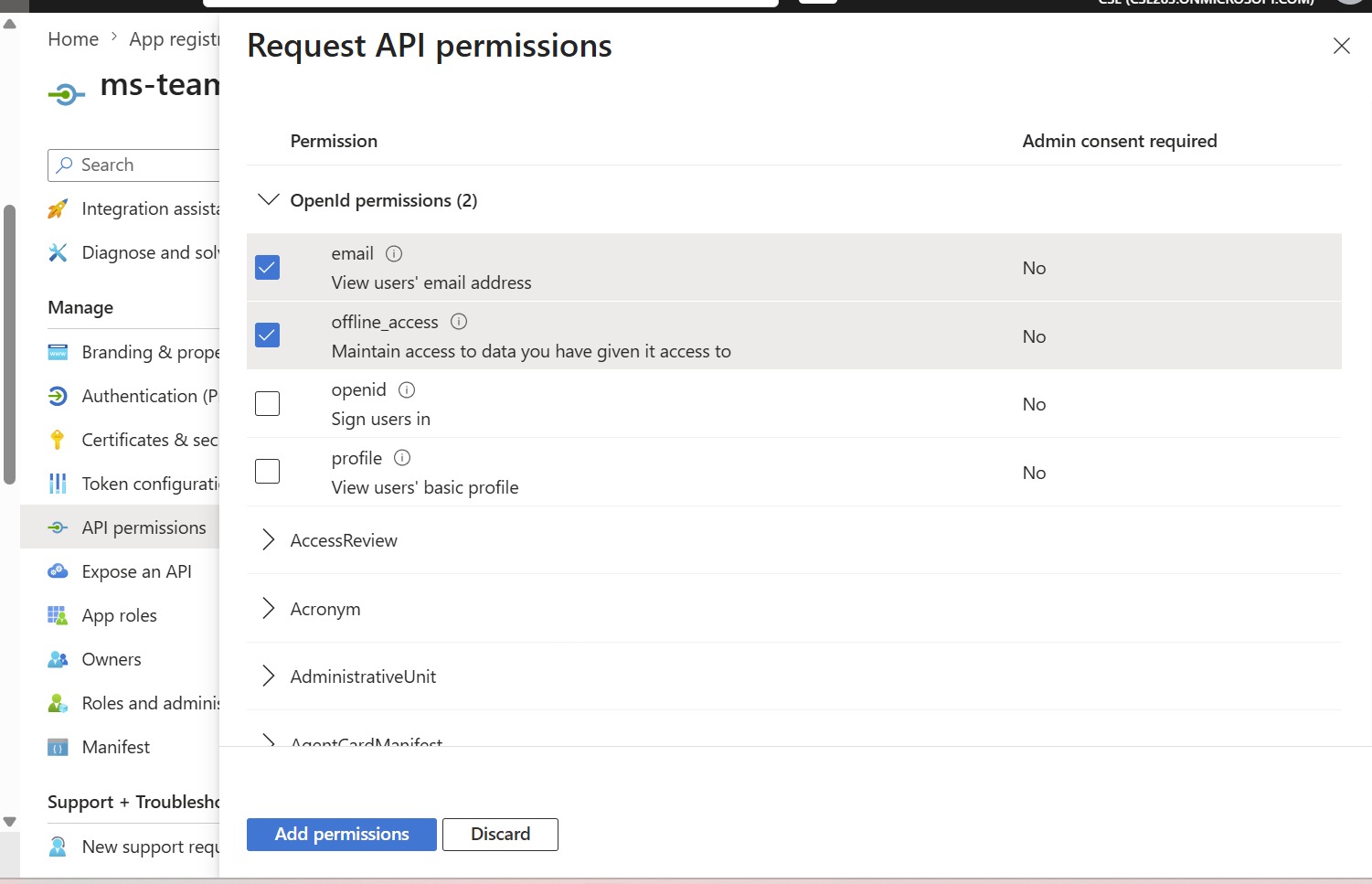
-
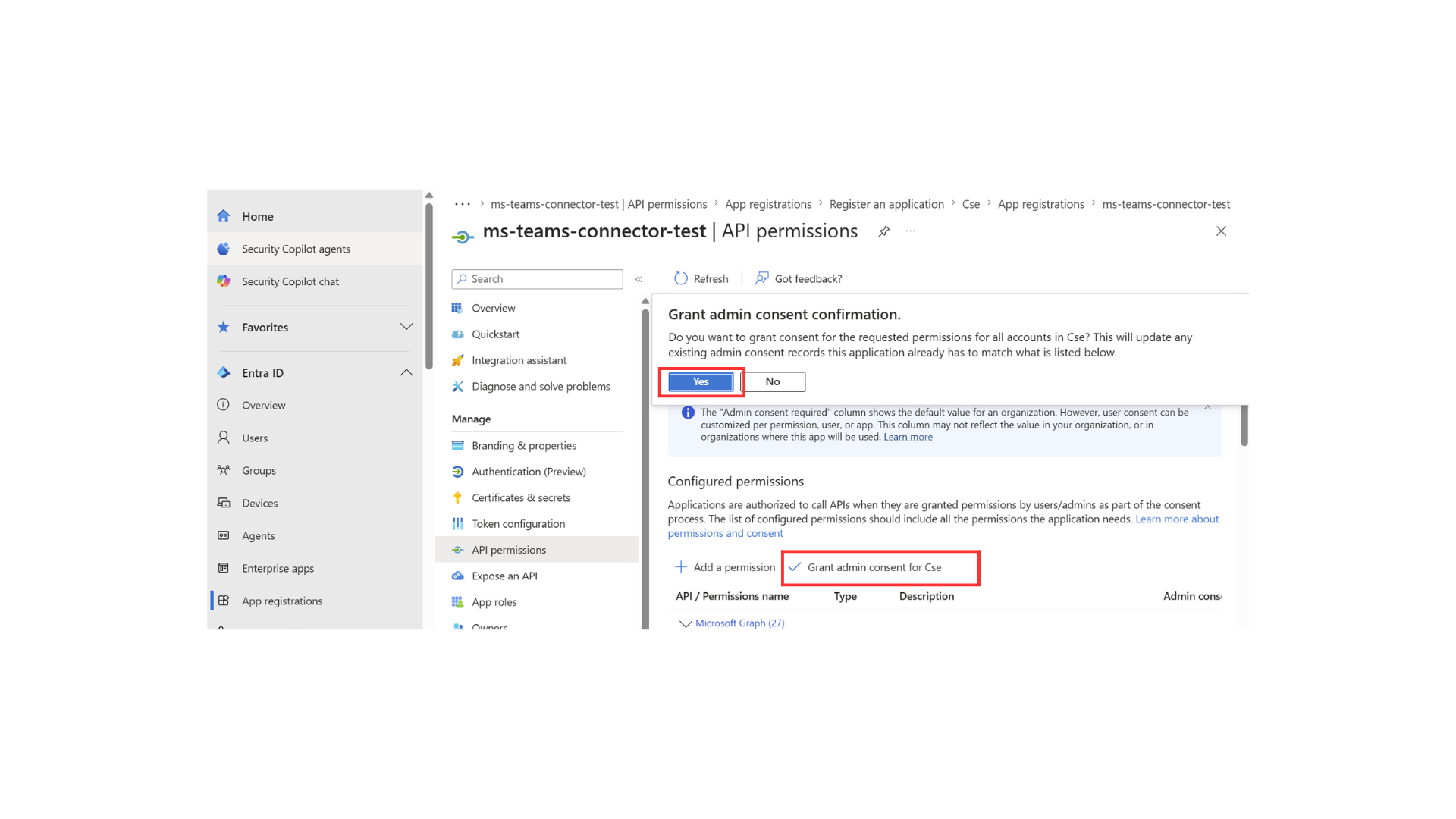
Back on the API permissions page, click Grant admin consent for <your tenant> and confirm Yes.
-
Confirm every permission now shows Granted for <your tenant> in the Status column.
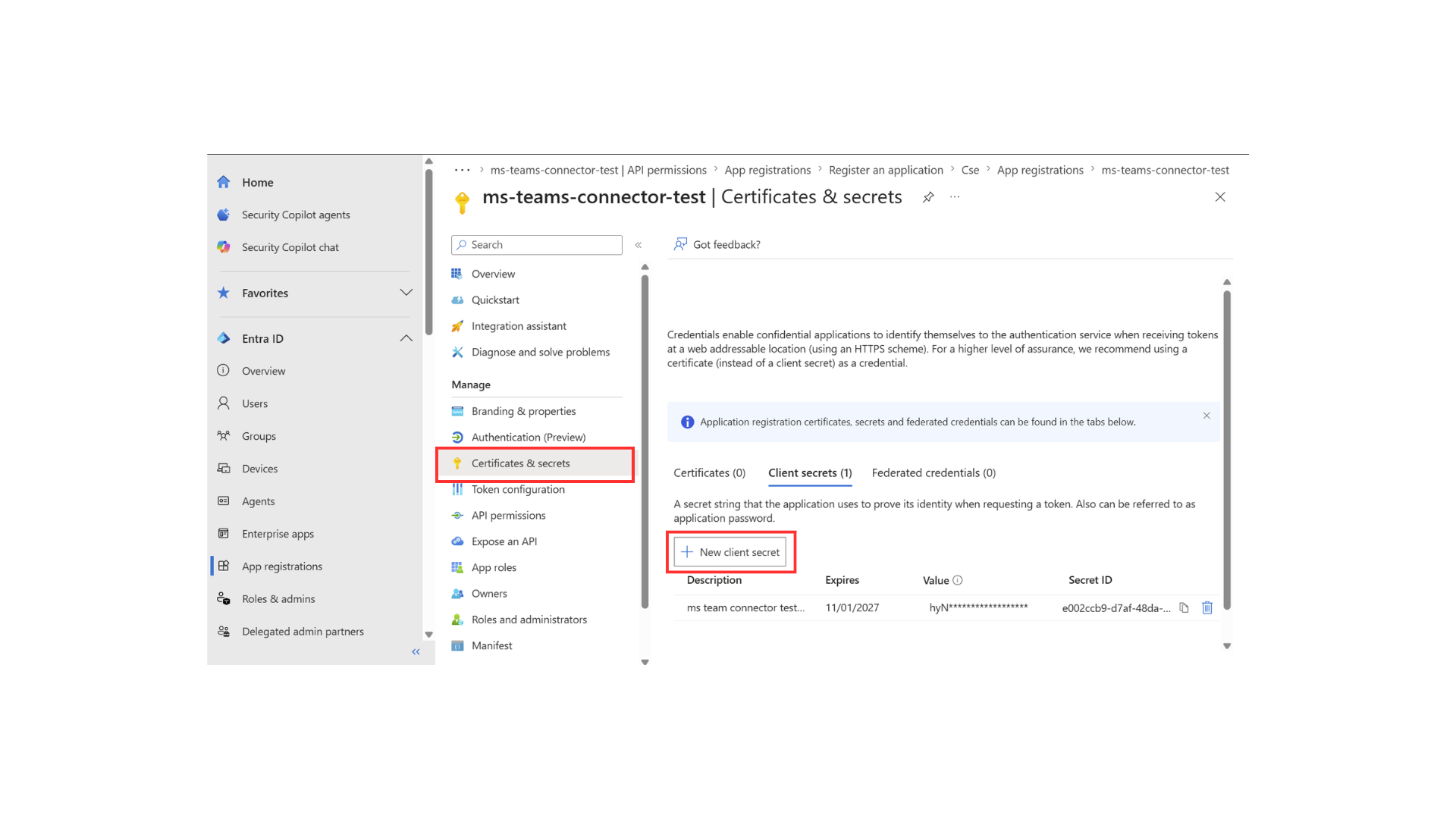
Step 3: Create a client secret
-
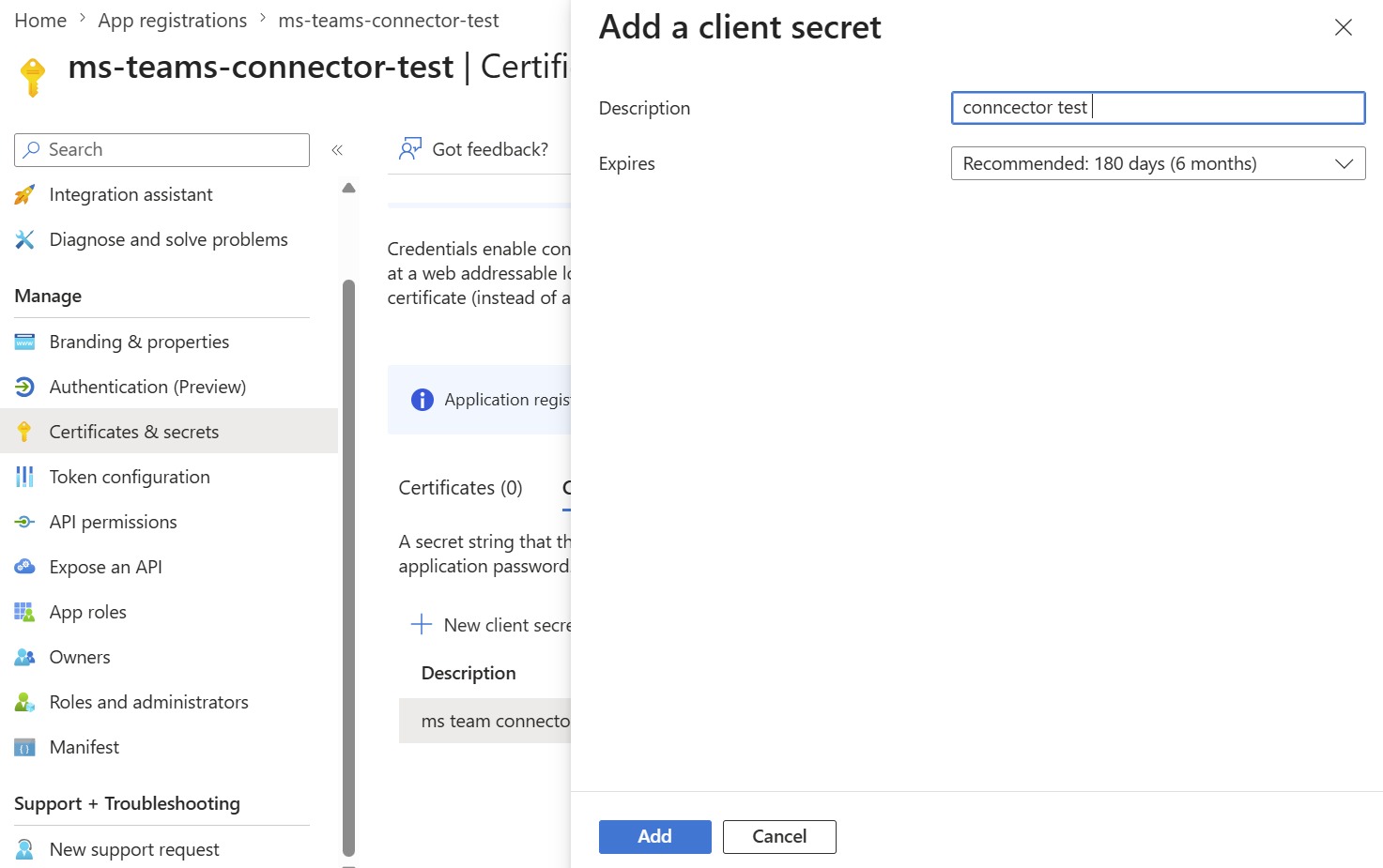
Go to Certificates & secrets > New client secret, add a description and an expiry, and click Add.
-
Copy the secret Value immediately — it is shown only once. (The Secret ID shown next to it is just a label for the secret, not a credential.)
Step 4: Obtain the credentials for Config.toml
Microsoft Entra's v2.0 endpoints for the app registered above:
- Authorize:
https://login.microsoftonline.com/<TENANT_ID>/oauth2/v2.0/authorize - Token:
https://login.microsoftonline.com/<TENANT_ID>/oauth2/v2.0/token
Replace <TENANT_ID>, <CLIENT_ID>, and <CLIENT_SECRET> below with the values from Steps 1 and 3.
Option A — Delegated access (refreshToken + authMode = "refresh_token")
Requires a one-time interactive sign-in.
1. Get an authorization code. This is an interactive sign-in + consent step, so it can't be curled — paste this URL into a browser instead:
https://login.microsoftonline.com/<TENANT_ID>/oauth2/v2.0/authorize?client_id=<CLIENT_ID>&response_type=code&redirect_uri=https%3A%2F%2Fjwt.ms&response_mode=query&scope=https%3A%2F%2Fgraph.microsoft.com%2F.default%20offline_access&state=12345
Sign in and accept the consent prompt. You'll land on https://jwt.ms/?code=<AUTH_CODE>&state=12345 — copy the code value from that URL. It's single-use and short-lived, so use it in the next step within a few minutes.
2. Exchange the code for a refresh token.
macOS / Linux (bash, zsh):
curl -X POST "https://login.microsoftonline.com/<TENANT_ID>/oauth2/v2.0/token" \ --data-urlencode "client_id=<CLIENT_ID>" \ --data-urlencode "client_secret=<CLIENT_SECRET>" \ --data-urlencode "scope=https://graph.microsoft.com/.default offline_access" \ --data-urlencode "code=<AUTH_CODE>" \ --data-urlencode "redirect_uri=https://jwt.ms" \ --data-urlencode "grant_type=authorization_code"
Windows (PowerShell — call curl.exe explicitly; plain curl is aliased to Invoke-WebRequest and takes different flags):
curl.exe -X POST "https://login.microsoftonline.com/<TENANT_ID>/oauth2/v2.0/token" ` --data-urlencode "client_id=<CLIENT_ID>" ` --data-urlencode "client_secret=<CLIENT_SECRET>" ` --data-urlencode "scope=https://graph.microsoft.com/.default offline_access" ` --data-urlencode "code=<AUTH_CODE>" ` --data-urlencode "redirect_uri=https://jwt.ms" ` --data-urlencode "grant_type=authorization_code"
The JSON response includes a refresh_token field — copy that value into Config.toml as refreshToken, alongside clientId, clientSecret, tenantId, and authMode = "refresh_token".
The
access_tokenin the same response is short-lived (~1 hour) and isn't used directly; the connector usesrefreshTokento mint new access tokens automatically on each call.
Option B — App-only access (authMode = "client_credentials")
No user, no redirect URI, and no /authorize step — the app authenticates as itself directly against /token. This requires Application permissions (not delegated), admin-consented, from Step 2.
macOS / Linux:
curl -X POST "https://login.microsoftonline.com/<TENANT_ID>/oauth2/v2.0/token" \ --data-urlencode "client_id=<CLIENT_ID>" \ --data-urlencode "client_secret=<CLIENT_SECRET>" \ --data-urlencode "scope=https://graph.microsoft.com/.default" \ --data-urlencode "grant_type=client_credentials"
Windows (PowerShell):
curl.exe -X POST "https://login.microsoftonline.com/<TENANT_ID>/oauth2/v2.0/token" ` --data-urlencode "client_id=<CLIENT_ID>" ` --data-urlencode "client_secret=<CLIENT_SECRET>" ` --data-urlencode "scope=https://graph.microsoft.com/.default" ` --data-urlencode "grant_type=client_credentials"
There's no refresh_token in this response — app-only tokens aren't refreshed; the connector just calls this same endpoint again with clientId/clientSecret/tenantId whenever a token expires. Set authMode = "client_credentials" in Config.toml and leave refreshToken unset.
Quickstart
To use the Microsoft Teams connector in your Ballerina application, modify the .bal file as follows:
Step 1: Import the module
import ballerina/io; import ballerinax/microsoft.teams;
Step 2: Instantiate a new connector
Create a Config.toml file with your OAuth2 credentials:
clientId = "<client-id>" clientSecret = "<client-secret>" refreshToken = "<refresh-token>" tenantId = "<tenant-id>"
Initialize the client with these credentials:
configurable string clientId = ?; configurable string clientSecret = ?; configurable string refreshToken = ?; configurable string tenantId = ?; teams:OAuth2RefreshTokenGrantConfig auth = { clientId, clientSecret, refreshToken, refreshUrl: string `https://login.microsoftonline.com/${tenantId}/oauth2/v2.0/token` }; teams:Client teamsClient = check new ({auth});
Step 3: Invoke the connector operation
public function main() returns error? { teams:ChannelCollectionResponse channels = check teamsClient->listChannels("<team-id>"); foreach teams:Channel channel in channels.value ?: [] { io:println(channel.displayName ?: ""); } }
Examples
The Microsoft Teams connector provides practical examples illustrating usage in various scenarios. Explore these examples, covering the following use cases:
- Team and channel setup — Provision a new team and create a channel within it.
- Channel message thread — Post a message to a channel, reply to it, and add a reaction.
- Channel member management — Create a private channel with an owner and list its members.
- Team tag management — Create a teamwork tag on a team and list all its tags.
Build from the source
Setting up the prerequisites
-
Download and install Java SE Development Kit (JDK) version 21. You can download it from either of the following sources:
Note: After installation, remember to set the
JAVA_HOMEenvironment variable to the directory where JDK was installed. -
Download and install Ballerina Swan Lake.
-
Download and install Docker.
Note: Ensure that the Docker daemon is running before executing any tests.
Building the source
Execute the following commands to build from the source:
-
To build the package:
./gradlew clean build -
To run the tests:
./gradlew clean test -
To build without the tests:
./gradlew clean build -x test -
To run tests against different environments:
./gradlew clean test -Pgroups=<Comma separated groups/test cases> -
To debug the package with a remote debugger:
./gradlew clean build -Pdebug=<port> -
To debug with the Ballerina language:
./gradlew clean build -PbalJavaDebug=<port> -
Publish the generated artifacts to the local Ballerina Central repository:
./gradlew clean build -PpublishToLocalCentral=true -
Publish the generated artifacts to the Ballerina Central repository:
./gradlew clean build -PpublishToCentral=true
Contribute to Ballerina
As an open-source project, Ballerina welcomes contributions from the community.
For more information, go to the contribution guidelines.
Code of conduct
All the contributors are encouraged to read the Ballerina Code of Conduct.
Useful links
- For more information go to the
microsoft.teamspackage. - For example demonstrations of the usage, go to Ballerina By Examples.
- Chat live with us via our Discord server.
- Post all technical questions on Stack Overflow with the #ballerina tag.
Clients
microsoft.teams: Client
This OData service is located at https://graph.microsoft.com/v1.0
Constructor
Gets invoked to initialize the connector.
init (ConnectionConfig config, string serviceUrl)- config ConnectionConfig - The configurations to be used when initializing the
connector
- serviceUrl string "https://graph.microsoft.com/v1.0" - URL of the target service
createTeam
Create team
Required payload fields: displayName, plus the template@odata.bind navigation binding that
selects the base template, e.g. "template@odata.bind": "https://graph.microsoft.com/v1.0/teamsTemplates('standard')".
When the calling app uses application (app-only) permissions, also include a members array with at
least one owner — an aadUserConversationMember with roles = ["owner"] and a user@odata.bind
binding to the user (https://graph.microsoft.com/v1.0/users('{user-id}')).
To create a team from an existing Microsoft 365 group, bind the group with group@odata.bind set to
https://graph.microsoft.com/v1.0/groups('{group-id}') together with template@odata.bind and omit
displayName (the group must have at least one owner). Team creation is asynchronous (see the note in
the function body).
Parameters
- payload Team - The team to create
getTeam
function getTeam(string teamId, map<string|string[]> headers, *GetTeamQueries queries) returns Team|errorGet team
Parameters
- teamId string - The unique identifier of team
- queries *GetTeamQueries - Queries to be sent with the request
deleteTeam
function deleteTeam(string teamId, DeleteTeamHeaders headers) returns error?Delete entity from teams
Parameters
- teamId string - The unique identifier of team
- headers DeleteTeamHeaders (default {}) - Headers to be sent with the request
Return Type
- error? - Success
updateTeam
function updateTeam(string teamId, Team payload, map<string|string[]> headers) returns Response|errorUpdate team
No fields are required; send only the team properties to change (for example displayName,
description, visibility, funSettings, memberSettings). Read-only properties are ignored.
listAllChannels
function listAllChannels(string teamId, map<string|string[]> headers, *ListAllChannelsQueries queries) returns ChannelCollectionResponse|errorList allChannels
Parameters
- teamId string - The unique identifier of team
- queries *ListAllChannelsQueries - Queries to be sent with the request
Return Type
- ChannelCollectionResponse|error - Retrieved collection
getAllChannel
function getAllChannel(string teamId, string channelId, map<string|string[]> headers, *GetAllChannelQueries queries) returns Channel|errorGet allChannels from teams
Parameters
- teamId string - The unique identifier of team
- channelId string - The unique identifier of channel
- queries *GetAllChannelQueries - Queries to be sent with the request
countAllChannels
function countAllChannels(string teamId, map<string|string[]> headers, *CountAllChannelsQueries queries) returns string|errorGet the number of the resource
Parameters
- teamId string - The unique identifier of team
- queries *CountAllChannelsQueries - Queries to be sent with the request
listChannels
function listChannels(string teamId, map<string|string[]> headers, *ListChannelsQueries queries) returns ChannelCollectionResponse|errorList channels
Parameters
- teamId string - The unique identifier of team
- queries *ListChannelsQueries - Queries to be sent with the request
Return Type
- ChannelCollectionResponse|error - Retrieved collection
createChannel
function createChannel(string teamId, Channel payload, map<string|string[]> headers) returns Response|errorCreate channel
Required payload fields: displayName (max 50 characters). A standard channel is created by
default. For a private or shared channel, also set membershipType ("private" / "shared") and
include a members array with exactly one owner — an aadUserConversationMember with
roles = ["owner"] and a user@odata.bind binding to the user
(https://graph.microsoft.com/v1.0/users('{user-id}')).
getChannel
function getChannel(string teamId, string channelId, map<string|string[]> headers, *GetChannelQueries queries) returns Channel|errorGet channel
Parameters
- teamId string - The unique identifier of team
- channelId string - The unique identifier of channel
- queries *GetChannelQueries - Queries to be sent with the request
deleteChannel
function deleteChannel(string teamId, string channelId, DeleteChannelHeaders headers) returns error?Delete channel
Parameters
- teamId string - The unique identifier of team
- channelId string - The unique identifier of channel
- headers DeleteChannelHeaders (default {}) - Headers to be sent with the request
Return Type
- error? - Success
updateChannel
function updateChannel(string teamId, string channelId, Channel payload, map<string|string[]> headers) returns Response|errorPatch channel
No fields are required; send only the channel properties to change (for example displayName,
description). The team's default General channel can't be renamed.
Parameters
- teamId string - The unique identifier of team
- channelId string - The unique identifier of channel
- payload Channel - The channel properties to update
listChannelAllMembers
function listChannelAllMembers(string teamId, string channelId, map<string|string[]> headers, *ListChannelAllMembersQueries queries) returns ConversationMemberCollectionResponse|errorList allMembers
Parameters
- teamId string - The unique identifier of team
- channelId string - The unique identifier of channel
- queries *ListChannelAllMembersQueries - Queries to be sent with the request
Return Type
- ConversationMemberCollectionResponse|error - Retrieved collection
createChannelAllMember
function createChannelAllMember(string teamId, string channelId, ConversationMember payload, map<string|string[]> headers) returns ConversationMember|errorAdd member to channel allMembers
Required payload fields: the user@odata.bind navigation binding
(https://graph.microsoft.com/v1.0/users('{user-id}')) and
roles (["owner"] for an owner, [] for a standard member). Members can be added only to private
and shared channels, and the user must already belong to the parent team's roster.
Parameters
- teamId string - The unique identifier of team
- channelId string - The unique identifier of channel
- payload ConversationMember - The member to create
Return Type
- ConversationMember|error - The created member
getChannelAllMember
function getChannelAllMember(string teamId, string channelId, string conversationMemberId, map<string|string[]> headers, *GetChannelAllMemberQueries queries) returns ConversationMember|errorGet allMembers from teams
Parameters
- teamId string - The unique identifier of team
- channelId string - The unique identifier of channel
- conversationMemberId string - The unique identifier of conversationMember
- queries *GetChannelAllMemberQueries - Queries to be sent with the request
Return Type
- ConversationMember|error - The retrieved member
deleteChannelAllMember
function deleteChannelAllMember(string teamId, string channelId, string conversationMemberId, DeleteChannelAllMemberHeaders headers) returns error?Remove member from channel allMembers
Parameters
- teamId string - The unique identifier of team
- channelId string - The unique identifier of channel
- conversationMemberId string - The unique identifier of conversationMember
- headers DeleteChannelAllMemberHeaders (default {}) - Headers to be sent with the request
Return Type
- error? - Success
updateChannelAllMember
function updateChannelAllMember(string teamId, string channelId, string conversationMemberId, ConversationMember payload, map<string|string[]> headers) returns ConversationMember|errorUpdate member in channel allMembers
Required payload field: roles (the new role set — ["owner"] to promote to owner, [] to
demote to a standard member).
Parameters
- teamId string - The unique identifier of team
- channelId string - The unique identifier of channel
- conversationMemberId string - The unique identifier of conversationMember
- payload ConversationMember - The member properties to update
Return Type
- ConversationMember|error - The updated member
countChannelAllMembers
function countChannelAllMembers(string teamId, string channelId, map<string|string[]> headers, *CountChannelAllMembersQueries queries) returns string|errorGet the number of the resource
Parameters
- teamId string - The unique identifier of team
- channelId string - The unique identifier of channel
- queries *CountChannelAllMembersQueries - Queries to be sent with the request
addChannelAllMembers
function addChannelAllMembers(string teamId, string channelId, AddMembersRequest payload, map<string|string[]> headers) returns ActionResultPartCollectionResponse|errorInvoke action add
Required: a non-empty values array (up to 200 members per call). Each entry requires the
user@odata.bind binding and roles (["owner"] or []).
Parameters
- teamId string - The unique identifier of team
- channelId string - The unique identifier of channel
- payload AddMembersRequest - Action parameters
Return Type
- ActionResultPartCollectionResponse|error - The result for each member
removeChannelAllMembers
function removeChannelAllMembers(string teamId, string channelId, AddMembersRequest payload, map<string|string[]> headers) returns ActionResultPartCollectionResponse|errorInvoke action remove
Required: a non-empty values array (up to 20 members per call). Each entry identifies the member
to remove by the user@odata.bind binding (https://graph.microsoft.com/v1.0/users('{user-id}')).
Parameters
- teamId string - The unique identifier of team
- channelId string - The unique identifier of channel
- payload AddMembersRequest - Action parameters
Return Type
- ActionResultPartCollectionResponse|error - The result for each member
listChannelEnabledApps
function listChannelEnabledApps(string teamId, string channelId, map<string|string[]> headers, *ListChannelEnabledAppsQueries queries) returns TeamsAppCollectionResponse|errorList enabledApps
Parameters
- teamId string - The unique identifier of team
- channelId string - The unique identifier of channel
- queries *ListChannelEnabledAppsQueries - Queries to be sent with the request
Return Type
- TeamsAppCollectionResponse|error - Retrieved collection
getChannelEnabledApp
function getChannelEnabledApp(string teamId, string channelId, string teamsAppId, map<string|string[]> headers, *GetChannelEnabledAppQueries queries) returns TeamsApp|errorGet teamsApp
Parameters
- teamId string - The unique identifier of team
- channelId string - The unique identifier of channel
- teamsAppId string - The unique identifier of teamsApp
- queries *GetChannelEnabledAppQueries - Queries to be sent with the request
countChannelEnabledApps
function countChannelEnabledApps(string teamId, string channelId, map<string|string[]> headers, *CountChannelEnabledAppsQueries queries) returns string|errorGet the number of the resource
Parameters
- teamId string - The unique identifier of team
- channelId string - The unique identifier of channel
- queries *CountChannelEnabledAppsQueries - Queries to be sent with the request
getChannelFilesFolder
function getChannelFilesFolder(string teamId, string channelId, map<string|string[]> headers, *GetChannelFilesFolderQueries queries) returns DriveItem|errorGet filesFolder
Parameters
- teamId string - The unique identifier of team
- channelId string - The unique identifier of channel
- queries *GetChannelFilesFolderQueries - Queries to be sent with the request
getChannelFilesFolderContent
function getChannelFilesFolderContent(string teamId, string channelId, map<string|string[]> headers, *GetChannelFilesFolderContentQueries queries) returns byte[]|errorGet channel filesFolder content
Parameters
- teamId string - The unique identifier of team
- channelId string - The unique identifier of channel
- queries *GetChannelFilesFolderContentQueries - Queries to be sent with the request
Return Type
- byte[]|error - Retrieved media content
updateChannelFilesFolderContent
function updateChannelFilesFolderContent(string teamId, string channelId, byte[] payload, map<string|string[]> headers) returns DriveItem|errorUpload channel filesFolder content
The payload is the raw file content, uploaded as application/octet-stream. Simple upload supports
files up to ~250 MB; larger files require an upload session, which this operation doesn't provide.
Parameters
- teamId string - The unique identifier of team
- channelId string - The unique identifier of channel
- payload byte[] - New media content
deleteChannelFilesFolderContent
function deleteChannelFilesFolderContent(string teamId, string channelId, DeleteChannelFilesFolderContentHeaders headers) returns error?Delete channel filesFolder content
Parameters
- teamId string - The unique identifier of team
- channelId string - The unique identifier of channel
- headers DeleteChannelFilesFolderContentHeaders (default {}) - Headers to be sent with the request
Return Type
- error? - Success
listChannelMembers
function listChannelMembers(string teamId, string channelId, map<string|string[]> headers, *ListChannelMembersQueries queries) returns ConversationMemberCollectionResponse|errorList members of a channel
Parameters
- teamId string - The unique identifier of team
- channelId string - The unique identifier of channel
- queries *ListChannelMembersQueries - Queries to be sent with the request
Return Type
- ConversationMemberCollectionResponse|error - Retrieved collection
createChannelMember
function createChannelMember(string teamId, string channelId, ConversationMember payload, map<string|string[]> headers) returns ConversationMember|errorAdd member to channel
Required payload fields: the user@odata.bind navigation binding
(https://graph.microsoft.com/v1.0/users('{user-id}')) and
roles (["owner"] for an owner, [] for a standard member). Members can be added only to private
and shared channels, and the user must already belong to the parent team's roster.
Parameters
- teamId string - The unique identifier of team
- channelId string - The unique identifier of channel
- payload ConversationMember - The member to create
Return Type
- ConversationMember|error - The created member
getChannelMember
function getChannelMember(string teamId, string channelId, string conversationMemberId, map<string|string[]> headers, *GetChannelMemberQueries queries) returns ConversationMember|errorGet member of channel
Parameters
- teamId string - The unique identifier of team
- channelId string - The unique identifier of channel
- conversationMemberId string - The unique identifier of conversationMember
- queries *GetChannelMemberQueries - Queries to be sent with the request
Return Type
- ConversationMember|error - The retrieved member
deleteChannelMember
function deleteChannelMember(string teamId, string channelId, string conversationMemberId, DeleteChannelMemberHeaders headers) returns error?Remove member from channel
Parameters
- teamId string - The unique identifier of team
- channelId string - The unique identifier of channel
- conversationMemberId string - The unique identifier of conversationMember
- headers DeleteChannelMemberHeaders (default {}) - Headers to be sent with the request
Return Type
- error? - Success
updateChannelMember
function updateChannelMember(string teamId, string channelId, string conversationMemberId, ConversationMember payload, map<string|string[]> headers) returns ConversationMember|errorUpdate member in channel
Required payload field: roles (the new role set — ["owner"] to promote to owner, [] to
demote to a standard member).
Parameters
- teamId string - The unique identifier of team
- channelId string - The unique identifier of channel
- conversationMemberId string - The unique identifier of conversationMember
- payload ConversationMember - The member properties to update
Return Type
- ConversationMember|error - The updated member
countChannelMembers
function countChannelMembers(string teamId, string channelId, map<string|string[]> headers, *CountChannelMembersQueries queries) returns string|errorGet the number of the resource
Parameters
- teamId string - The unique identifier of team
- channelId string - The unique identifier of channel
- queries *CountChannelMembersQueries - Queries to be sent with the request
addChannelMembers
function addChannelMembers(string teamId, string channelId, AddMembersRequest payload, map<string|string[]> headers) returns ActionResultPartCollectionResponse|errorInvoke action add
Required: a non-empty values array (up to 200 members per call). Each entry requires the
user@odata.bind binding and roles (["owner"] or []).
Parameters
- teamId string - The unique identifier of team
- channelId string - The unique identifier of channel
- payload AddMembersRequest - Action parameters
Return Type
- ActionResultPartCollectionResponse|error - The result for each member
removeChannelMembers
function removeChannelMembers(string teamId, string channelId, AddMembersRequest payload, map<string|string[]> headers) returns ActionResultPartCollectionResponse|errorInvoke action remove
Required: a non-empty values array (up to 20 members per call). Each entry identifies the member
to remove by the user@odata.bind binding (https://graph.microsoft.com/v1.0/users('{user-id}')).
Parameters
- teamId string - The unique identifier of team
- channelId string - The unique identifier of channel
- payload AddMembersRequest - Action parameters
Return Type
- ActionResultPartCollectionResponse|error - The result for each member
listChannelMessages
function listChannelMessages(string teamId, string channelId, map<string|string[]> headers, *ListChannelMessagesQueries queries) returns ChatMessageCollectionResponse|errorList channel messages
Parameters
- teamId string - The unique identifier of team
- channelId string - The unique identifier of channel
- queries *ListChannelMessagesQueries - Queries to be sent with the request
Return Type
- ChatMessageCollectionResponse|error - Retrieved collection
createChannelMessage
function createChannelMessage(string teamId, string channelId, ChatMessage payload, map<string|string[]> headers) returns ChatMessage|errorSend chatMessage in channel
Required payload fields: body with a non-empty content (set body.contentType to "html" or
"text"). Optional: attachments, mentions (referenced from HTML content by an at-mention tag), and
hostedContents for inline images (each referenced by its @microsoft.graph.temporaryId).
Parameters
- teamId string - The unique identifier of team
- channelId string - The unique identifier of channel
- payload ChatMessage - The message to create
Return Type
- ChatMessage|error - The created message
getChannelMessage
function getChannelMessage(string teamId, string channelId, string chatMessageId, map<string|string[]> headers, *GetChannelMessageQueries queries) returns ChatMessage|errorGet chatMessage in a channel or chat
Parameters
- teamId string - The unique identifier of team
- channelId string - The unique identifier of channel
- chatMessageId string - The unique identifier of chatMessage
- queries *GetChannelMessageQueries - Queries to be sent with the request
Return Type
- ChatMessage|error - The retrieved message
deleteChannelMessage
function deleteChannelMessage(string teamId, string channelId, string chatMessageId, DeleteChannelMessageHeaders headers) returns error?Delete channel message
Parameters
- teamId string - The unique identifier of team
- channelId string - The unique identifier of channel
- chatMessageId string - The unique identifier of chatMessage
- headers DeleteChannelMessageHeaders (default {}) - Headers to be sent with the request
Return Type
- error? - Success
updateChannelMessage
function updateChannelMessage(string teamId, string channelId, string chatMessageId, ChatMessage payload, map<string|string[]> headers) returns Response|errorUpdate chatMessage
Send only the properties to change — typically body with the new content. Note: Microsoft
Graph v1.0 restricts which chatMessage properties may be updated (for example, policyViolation).
Parameters
- teamId string - The unique identifier of team
- channelId string - The unique identifier of channel
- chatMessageId string - The unique identifier of chatMessage
- payload ChatMessage - The message properties to update
listChannelMessageHostedContents
function listChannelMessageHostedContents(string teamId, string channelId, string chatMessageId, map<string|string[]> headers, *ListChannelMessageHostedContentsQueries queries) returns ChatMessageHostedContentCollectionResponse|errorList hostedContents
Parameters
- teamId string - The unique identifier of team
- channelId string - The unique identifier of channel
- chatMessageId string - The unique identifier of chatMessage
- queries *ListChannelMessageHostedContentsQueries - Queries to be sent with the request
Return Type
- ChatMessageHostedContentCollectionResponse|error - Retrieved collection
createChannelMessageHostedContent
function createChannelMessageHostedContent(string teamId, string channelId, string chatMessageId, ChatMessageHostedContent payload, map<string|string[]> headers) returns ChatMessageHostedContent|errorCreate channel message hosted content
Required payload fields: contentBytes (base64-encoded content) and contentType (the MIME type,
for example "image/png"). Inline images are usually created together with the message instead, via
the message's hostedContents array.
Parameters
- teamId string - The unique identifier of team
- channelId string - The unique identifier of channel
- chatMessageId string - The unique identifier of chatMessage
- payload ChatMessageHostedContent - The hosted content to create
Return Type
- ChatMessageHostedContent|error - The created hosted content
getChannelMessageHostedContent
function getChannelMessageHostedContent(string teamId, string channelId, string chatMessageId, string chatMessageHostedContentId, map<string|string[]> headers, *GetChannelMessageHostedContentQueries queries) returns ChatMessageHostedContent|errorGet hostedContents from teams
Parameters
- teamId string - The unique identifier of team
- channelId string - The unique identifier of channel
- chatMessageId string - The unique identifier of chatMessage
- chatMessageHostedContentId string - The unique identifier of chatMessageHostedContent
- queries *GetChannelMessageHostedContentQueries - Queries to be sent with the request
Return Type
- ChatMessageHostedContent|error - The retrieved hosted content
deleteChannelMessageHostedContent
function deleteChannelMessageHostedContent(string teamId, string channelId, string chatMessageId, string chatMessageHostedContentId, DeleteChannelMessageHostedContentHeaders headers) returns error?Delete channel message hosted content
Parameters
- teamId string - The unique identifier of team
- channelId string - The unique identifier of channel
- chatMessageId string - The unique identifier of chatMessage
- chatMessageHostedContentId string - The unique identifier of chatMessageHostedContent
- headers DeleteChannelMessageHostedContentHeaders (default {}) - Headers to be sent with the request
Return Type
- error? - Success
updateChannelMessageHostedContent
function updateChannelMessageHostedContent(string teamId, string channelId, string chatMessageId, string chatMessageHostedContentId, ChatMessageHostedContent payload, map<string|string[]> headers) returns ChatMessageHostedContent|errorUpdate channel message hosted content
Sends hosted-content properties (contentBytes, contentType). Note: Microsoft Graph v1.0 offers
limited support for updating message hosted content; this is provided for API completeness.
Parameters
- teamId string - The unique identifier of team
- channelId string - The unique identifier of channel
- chatMessageId string - The unique identifier of chatMessage
- chatMessageHostedContentId string - The unique identifier of chatMessageHostedContent
- payload ChatMessageHostedContent - The hosted content properties to update
Return Type
- ChatMessageHostedContent|error - The updated hosted content
getChannelMessageHostedContentValue
function getChannelMessageHostedContentValue(string teamId, string channelId, string chatMessageId, string chatMessageHostedContentId, map<string|string[]> headers) returns byte[]|errorList hostedContents
Parameters
- teamId string - The unique identifier of team
- channelId string - The unique identifier of channel
- chatMessageId string - The unique identifier of chatMessage
- chatMessageHostedContentId string - The unique identifier of chatMessageHostedContent
Return Type
- byte[]|error - Retrieved media content
updateChannelMessageHostedContentValue
function updateChannelMessageHostedContentValue(string teamId, string channelId, string chatMessageId, string chatMessageHostedContentId, byte[] payload, map<string|string[]> headers) returns error?Upload channel message hosted content
The payload is the raw media bytes (for example an image), uploaded as application/octet-stream.
Parameters
- teamId string - The unique identifier of team
- channelId string - The unique identifier of channel
- chatMessageId string - The unique identifier of chatMessage
- chatMessageHostedContentId string - The unique identifier of chatMessageHostedContent
- payload byte[] - New media content
Return Type
- error? - Success
deleteChannelMessageHostedContentValue
function deleteChannelMessageHostedContentValue(string teamId, string channelId, string chatMessageId, string chatMessageHostedContentId, DeleteChannelMessageHostedContentValueHeaders headers) returns error?Delete channel message hosted content value
Parameters
- teamId string - The unique identifier of team
- channelId string - The unique identifier of channel
- chatMessageId string - The unique identifier of chatMessage
- chatMessageHostedContentId string - The unique identifier of chatMessageHostedContent
- headers DeleteChannelMessageHostedContentValueHeaders (default {}) - Headers to be sent with the request
Return Type
- error? - Success
countChannelMessageHostedContents
function countChannelMessageHostedContents(string teamId, string channelId, string chatMessageId, map<string|string[]> headers, *CountChannelMessageHostedContentsQueries queries) returns string|errorGet the number of the resource
Parameters
- teamId string - The unique identifier of team
- channelId string - The unique identifier of channel
- chatMessageId string - The unique identifier of chatMessage
- queries *CountChannelMessageHostedContentsQueries - Queries to be sent with the request
setReactionChannelMessage
function setReactionChannelMessage(string teamId, string channelId, string chatMessageId, SetReactionRequest payload, map<string|string[]> headers) returns error?Invoke action setReaction
Required payload field: reactionType. On Microsoft Graph v1.0 this must be a Unicode emoji (for
example "👍"); reaction names such as "like" are rejected with HTTP 400.
Parameters
- teamId string - The unique identifier of team
- channelId string - The unique identifier of channel
- chatMessageId string - The unique identifier of chatMessage
- payload SetReactionRequest - Action parameters
Return Type
- error? - Success
softDeleteChannelMessage
function softDeleteChannelMessage(string teamId, string channelId, string chatMessageId, map<string|string[]> headers) returns error?Invoke action softDelete
Parameters
- teamId string - The unique identifier of team
- channelId string - The unique identifier of channel
- chatMessageId string - The unique identifier of chatMessage
Return Type
- error? - Success
undoSoftDeleteChannelMessage
function undoSoftDeleteChannelMessage(string teamId, string channelId, string chatMessageId, map<string|string[]> headers) returns error?Invoke action undoSoftDelete
Parameters
- teamId string - The unique identifier of team
- channelId string - The unique identifier of channel
- chatMessageId string - The unique identifier of chatMessage
Return Type
- error? - Success
unsetReactionChannelMessage
function unsetReactionChannelMessage(string teamId, string channelId, string chatMessageId, SetReactionRequest payload, map<string|string[]> headers) returns error?Invoke action unsetReaction
Required payload field: reactionType. On Microsoft Graph v1.0 this must be a Unicode emoji (for
example "👍"); reaction names such as "like" are rejected with HTTP 400.
Parameters
- teamId string - The unique identifier of team
- channelId string - The unique identifier of channel
- chatMessageId string - The unique identifier of chatMessage
- payload SetReactionRequest - Action parameters
Return Type
- error? - Success
listChannelMessageReplies
function listChannelMessageReplies(string teamId, string channelId, string chatMessageId, map<string|string[]> headers, *ListChannelMessageRepliesQueries queries) returns ChatMessageCollectionResponse|errorList replies
Parameters
- teamId string - The unique identifier of team
- channelId string - The unique identifier of channel
- chatMessageId string - The unique identifier of chatMessage
- queries *ListChannelMessageRepliesQueries - Queries to be sent with the request
Return Type
- ChatMessageCollectionResponse|error - Retrieved collection
createChannelMessageReply
function createChannelMessageReply(string teamId, string channelId, string chatMessageId, ChatMessage payload, map<string|string[]> headers) returns ChatMessage|errorReply to a message in a channel
Required payload fields: body with a non-empty content (set body.contentType to "html" or
"text"). Optional: attachments, mentions (referenced from HTML content by an at-mention tag), and
hostedContents for inline images (each referenced by its @microsoft.graph.temporaryId).
Parameters
- teamId string - The unique identifier of team
- channelId string - The unique identifier of channel
- chatMessageId string - The unique identifier of chatMessage
- payload ChatMessage - The message to create
Return Type
- ChatMessage|error - The created message
getChannelMessageReply
function getChannelMessageReply(string teamId, string channelId, string chatMessageId, string chatMessageId1, map<string|string[]> headers, *GetChannelMessageReplyQueries queries) returns ChatMessage|errorGet chatMessage in a channel or chat
Parameters
- teamId string - The unique identifier of team
- channelId string - The unique identifier of channel
- chatMessageId string - The unique identifier of chatMessage
- chatMessageId1 string - The unique identifier of chatMessage
- queries *GetChannelMessageReplyQueries - Queries to be sent with the request
Return Type
- ChatMessage|error - The retrieved message
deleteChannelMessageReply
function deleteChannelMessageReply(string teamId, string channelId, string chatMessageId, string chatMessageId1, DeleteChannelMessageReplyHeaders headers) returns error?Delete channel message reply
Parameters
- teamId string - The unique identifier of team
- channelId string - The unique identifier of channel
- chatMessageId string - The unique identifier of chatMessage
- chatMessageId1 string - The unique identifier of chatMessage
- headers DeleteChannelMessageReplyHeaders (default {}) - Headers to be sent with the request
Return Type
- error? - Success
updateChannelMessageReply
function updateChannelMessageReply(string teamId, string channelId, string chatMessageId, string chatMessageId1, ChatMessage payload, map<string|string[]> headers) returns Response|errorUpdate channel message reply
Send only the properties to change — typically body with the new content. Note: Microsoft
Graph v1.0 restricts which chatMessage properties may be updated (for example, policyViolation).
Parameters
- teamId string - The unique identifier of team
- channelId string - The unique identifier of channel
- chatMessageId string - The unique identifier of chatMessage
- chatMessageId1 string - The unique identifier of chatMessage
- payload ChatMessage - The message properties to update
listChannelMessageReplyHostedContents
function listChannelMessageReplyHostedContents(string teamId, string channelId, string chatMessageId, string chatMessageId1, map<string|string[]> headers, *ListChannelMessageReplyHostedContentsQueries queries) returns ChatMessageHostedContentCollectionResponse|errorList hostedContents
Parameters
- teamId string - The unique identifier of team
- channelId string - The unique identifier of channel
- chatMessageId string - The unique identifier of chatMessage
- chatMessageId1 string - The unique identifier of chatMessage
- queries *ListChannelMessageReplyHostedContentsQueries - Queries to be sent with the request
Return Type
- ChatMessageHostedContentCollectionResponse|error - Retrieved collection
createChannelMessageReplyHostedContent
function createChannelMessageReplyHostedContent(string teamId, string channelId, string chatMessageId, string chatMessageId1, ChatMessageHostedContent payload, map<string|string[]> headers) returns ChatMessageHostedContent|errorCreate channel reply hosted content
Required payload fields: contentBytes (base64-encoded content) and contentType (the MIME type,
for example "image/png"). Inline images are usually created together with the message instead, via
the message's hostedContents array.
Parameters
- teamId string - The unique identifier of team
- channelId string - The unique identifier of channel
- chatMessageId string - The unique identifier of chatMessage
- chatMessageId1 string - The unique identifier of chatMessage
- payload ChatMessageHostedContent - The hosted content to create
Return Type
- ChatMessageHostedContent|error - The created hosted content
getChannelMessageReplyHostedContent
function getChannelMessageReplyHostedContent(string teamId, string channelId, string chatMessageId, string chatMessageId1, string chatMessageHostedContentId, map<string|string[]> headers, *GetChannelMessageReplyHostedContentQueries queries) returns ChatMessageHostedContent|errorGet hostedContents from teams
Parameters
- teamId string - The unique identifier of team
- channelId string - The unique identifier of channel
- chatMessageId string - The unique identifier of chatMessage
- chatMessageId1 string - The unique identifier of chatMessage
- chatMessageHostedContentId string - The unique identifier of chatMessageHostedContent
- queries *GetChannelMessageReplyHostedContentQueries - Queries to be sent with the request
Return Type
- ChatMessageHostedContent|error - The retrieved hosted content
deleteChannelMessageReplyHostedContent
function deleteChannelMessageReplyHostedContent(string teamId, string channelId, string chatMessageId, string chatMessageId1, string chatMessageHostedContentId, DeleteChannelMessageReplyHostedContentHeaders headers) returns error?Delete channel reply hosted content
Parameters
- teamId string - The unique identifier of team
- channelId string - The unique identifier of channel
- chatMessageId string - The unique identifier of chatMessage
- chatMessageId1 string - The unique identifier of chatMessage
- chatMessageHostedContentId string - The unique identifier of chatMessageHostedContent
- headers DeleteChannelMessageReplyHostedContentHeaders (default {}) - Headers to be sent with the request
Return Type
- error? - Success
updateChannelMessageReplyHostedContent
function updateChannelMessageReplyHostedContent(string teamId, string channelId, string chatMessageId, string chatMessageId1, string chatMessageHostedContentId, ChatMessageHostedContent payload, map<string|string[]> headers) returns ChatMessageHostedContent|errorUpdate channel reply hosted content
Sends hosted-content properties (contentBytes, contentType). Note: Microsoft Graph v1.0 offers
limited support for updating message hosted content; this is provided for API completeness.
Parameters
- teamId string - The unique identifier of team
- channelId string - The unique identifier of channel
- chatMessageId string - The unique identifier of chatMessage
- chatMessageId1 string - The unique identifier of chatMessage
- chatMessageHostedContentId string - The unique identifier of chatMessageHostedContent
- payload ChatMessageHostedContent - The hosted content properties to update
Return Type
- ChatMessageHostedContent|error - The updated hosted content
getChannelMessageReplyHostedContentValue
function getChannelMessageReplyHostedContentValue(string teamId, string channelId, string chatMessageId, string chatMessageId1, string chatMessageHostedContentId, map<string|string[]> headers) returns byte[]|errorList hostedContents
Parameters
- teamId string - The unique identifier of team
- channelId string - The unique identifier of channel
- chatMessageId string - The unique identifier of chatMessage
- chatMessageId1 string - The unique identifier of chatMessage
- chatMessageHostedContentId string - The unique identifier of chatMessageHostedContent
Return Type
- byte[]|error - Retrieved media content
updateChannelMessageReplyHostedContentValue
function updateChannelMessageReplyHostedContentValue(string teamId, string channelId, string chatMessageId, string chatMessageId1, string chatMessageHostedContentId, byte[] payload, map<string|string[]> headers) returns error?Upload channel reply hosted content
The payload is the raw media bytes (for example an image), uploaded as application/octet-stream.
Parameters
- teamId string - The unique identifier of team
- channelId string - The unique identifier of channel
- chatMessageId string - The unique identifier of chatMessage
- chatMessageId1 string - The unique identifier of chatMessage
- chatMessageHostedContentId string - The unique identifier of chatMessageHostedContent
- payload byte[] - New media content
Return Type
- error? - Success
deleteChannelMessageReplyHostedContentValue
function deleteChannelMessageReplyHostedContentValue(string teamId, string channelId, string chatMessageId, string chatMessageId1, string chatMessageHostedContentId, DeleteChannelMessageReplyHostedContentValueHeaders headers) returns error?Delete channel reply hosted content value
Parameters
- teamId string - The unique identifier of team
- channelId string - The unique identifier of channel
- chatMessageId string - The unique identifier of chatMessage
- chatMessageId1 string - The unique identifier of chatMessage
- chatMessageHostedContentId string - The unique identifier of chatMessageHostedContent
- headers DeleteChannelMessageReplyHostedContentValueHeaders (default {}) - Headers to be sent with the request
Return Type
- error? - Success
countChannelMessageReplyHostedContents
function countChannelMessageReplyHostedContents(string teamId, string channelId, string chatMessageId, string chatMessageId1, map<string|string[]> headers, *CountChannelMessageReplyHostedContentsQueries queries) returns string|errorGet the number of the resource
Parameters
- teamId string - The unique identifier of team
- channelId string - The unique identifier of channel
- chatMessageId string - The unique identifier of chatMessage
- chatMessageId1 string - The unique identifier of chatMessage
- queries *CountChannelMessageReplyHostedContentsQueries - Queries to be sent with the request
setReactionChannelMessageReply
function setReactionChannelMessageReply(string teamId, string channelId, string chatMessageId, string chatMessageId1, SetReactionRequest payload, map<string|string[]> headers) returns error?Invoke action setReaction
Required payload field: reactionType. On Microsoft Graph v1.0 this must be a Unicode emoji (for
example "👍"); reaction names such as "like" are rejected with HTTP 400.
Parameters
- teamId string - The unique identifier of team
- channelId string - The unique identifier of channel
- chatMessageId string - The unique identifier of chatMessage
- chatMessageId1 string - The unique identifier of chatMessage
- payload SetReactionRequest - Action parameters
Return Type
- error? - Success
softDeleteChannelMessageReply
function softDeleteChannelMessageReply(string teamId, string channelId, string chatMessageId, string chatMessageId1, map<string|string[]> headers) returns error?Invoke action softDelete
Parameters
- teamId string - The unique identifier of team
- channelId string - The unique identifier of channel
- chatMessageId string - The unique identifier of chatMessage
- chatMessageId1 string - The unique identifier of chatMessage
Return Type
- error? - Success
undoSoftDeleteChannelMessageReply
function undoSoftDeleteChannelMessageReply(string teamId, string channelId, string chatMessageId, string chatMessageId1, map<string|string[]> headers) returns error?Invoke action undoSoftDelete
Parameters
- teamId string - The unique identifier of team
- channelId string - The unique identifier of channel
- chatMessageId string - The unique identifier of chatMessage
- chatMessageId1 string - The unique identifier of chatMessage
Return Type
- error? - Success
unsetReactionChannelMessageReply
function unsetReactionChannelMessageReply(string teamId, string channelId, string chatMessageId, string chatMessageId1, SetReactionRequest payload, map<string|string[]> headers) returns error?Invoke action unsetReaction
Required payload field: reactionType. On Microsoft Graph v1.0 this must be a Unicode emoji (for
example "👍"); reaction names such as "like" are rejected with HTTP 400.
Parameters
- teamId string - The unique identifier of team
- channelId string - The unique identifier of channel
- chatMessageId string - The unique identifier of chatMessage
- chatMessageId1 string - The unique identifier of chatMessage
- payload SetReactionRequest - Action parameters
Return Type
- error? - Success
countChannelMessageReplies
function countChannelMessageReplies(string teamId, string channelId, string chatMessageId, map<string|string[]> headers, *CountChannelMessageRepliesQueries queries) returns string|errorGet the number of the resource
Parameters
- teamId string - The unique identifier of team
- channelId string - The unique identifier of channel
- chatMessageId string - The unique identifier of chatMessage
- queries *CountChannelMessageRepliesQueries - Queries to be sent with the request
getChannelMessageRepliesDelta
function getChannelMessageRepliesDelta(string teamId, string channelId, string chatMessageId, map<string|string[]> headers, *GetChannelMessageRepliesDeltaQueries queries) returns ChatMessageDeltaCollectionResponse|errorInvoke function delta
Parameters
- teamId string - The unique identifier of team
- channelId string - The unique identifier of channel
- chatMessageId string - The unique identifier of chatMessage
- queries *GetChannelMessageRepliesDeltaQueries - Queries to be sent with the request
Return Type
- ChatMessageDeltaCollectionResponse|error - Retrieved collection
replyWithQuoteChannelMessageReplies
function replyWithQuoteChannelMessageReplies(string teamId, string channelId, string chatMessageId, ReplyWithQuoteRequest payload, map<string|string[]> headers) returns ChatMessageResponse|errorInvoke action replyWithQuote
Required payload fields: messageIds (id(s) of the message(s) being quoted, up to 10) and
replyMessage (a chatMessage whose body.content holds the reply text). Note: on Microsoft Graph
v1.0 replyWithQuote is documented for chats, so channel-scoped support may be limited.
Parameters
- teamId string - The unique identifier of team
- channelId string - The unique identifier of channel
- chatMessageId string - The unique identifier of chatMessage
- payload ReplyWithQuoteRequest - Action parameters
Return Type
- ChatMessageResponse|error - The created reply message
countChannelMessages
function countChannelMessages(string teamId, string channelId, map<string|string[]> headers, *CountChannelMessagesQueries queries) returns string|errorGet the number of the resource
Parameters
- teamId string - The unique identifier of team
- channelId string - The unique identifier of channel
- queries *CountChannelMessagesQueries - Queries to be sent with the request
getChannelMessagesDelta
function getChannelMessagesDelta(string teamId, string channelId, map<string|string[]> headers, *GetChannelMessagesDeltaQueries queries) returns ChatMessageDeltaCollectionResponse|errorInvoke function delta
Parameters
- teamId string - The unique identifier of team
- channelId string - The unique identifier of channel
- queries *GetChannelMessagesDeltaQueries - Queries to be sent with the request
Return Type
- ChatMessageDeltaCollectionResponse|error - Retrieved collection
replyWithQuoteChannelMessages
function replyWithQuoteChannelMessages(string teamId, string channelId, ReplyWithQuoteRequest payload, map<string|string[]> headers) returns ChatMessageResponse|errorInvoke action replyWithQuote
Required payload fields: messageIds (id(s) of the message(s) being quoted, up to 10) and
replyMessage (a chatMessage whose body.content holds the reply text). Note: on Microsoft Graph
v1.0 replyWithQuote is documented for chats, so channel-scoped support may be limited.
Parameters
- teamId string - The unique identifier of team
- channelId string - The unique identifier of channel
- payload ReplyWithQuoteRequest - Action parameters
Return Type
- ChatMessageResponse|error - The created reply message
listChannelTabs
function listChannelTabs(string teamId, string channelId, map<string|string[]> headers, *ListChannelTabsQueries queries) returns TeamsTabCollectionResponse|errorList tabs in channel
Parameters
- teamId string - The unique identifier of team
- channelId string - The unique identifier of channel
- queries *ListChannelTabsQueries - Queries to be sent with the request
Return Type
- TeamsTabCollectionResponse|error - Retrieved collection
createChannelTab
function createChannelTab(string teamId, string channelId, TeamsTab payload, map<string|string[]> headers) returns TeamsTab|errorAdd tab to channel
Required payload fields: displayName and the teamsApp@odata.bind navigation binding
(https://graph.microsoft.com/v1.0/appCatalogs/teamsApps/{app-id}); the app must already be installed
in the team. configuration (entityId, contentUrl, ...) is optional. For a static tab, omit
displayName/configuration — Graph reads them from the app manifest and otherwise returns 400.
Parameters
- teamId string - The unique identifier of team
- channelId string - The unique identifier of channel
- payload TeamsTab - The tab to create
getChannelTab
function getChannelTab(string teamId, string channelId, string teamsTabId, map<string|string[]> headers, *GetChannelTabQueries queries) returns TeamsTab|errorGet tab
Parameters
- teamId string - The unique identifier of team
- channelId string - The unique identifier of channel
- teamsTabId string - The unique identifier of teamsTab
- queries *GetChannelTabQueries - Queries to be sent with the request
deleteChannelTab
function deleteChannelTab(string teamId, string channelId, string teamsTabId, DeleteChannelTabHeaders headers) returns error?Delete tab from channel
Parameters
- teamId string - The unique identifier of team
- channelId string - The unique identifier of channel
- teamsTabId string - The unique identifier of teamsTab
- headers DeleteChannelTabHeaders (default {}) - Headers to be sent with the request
Return Type
- error? - Success
updateChannelTab
function updateChannelTab(string teamId, string channelId, string teamsTabId, TeamsTab payload, map<string|string[]> headers) returns TeamsTab|errorUpdate tab
No fields are required; send only the tab properties to change (for example displayName,
configuration).
Parameters
- teamId string - The unique identifier of team
- channelId string - The unique identifier of channel
- teamsTabId string - The unique identifier of teamsTab
- payload TeamsTab - The tab properties to update
getChannelTabTeamsApp
function getChannelTabTeamsApp(string teamId, string channelId, string teamsTabId, map<string|string[]> headers, *GetChannelTabTeamsAppQueries queries) returns TeamsApp|errorGet teamsApp from teams
Parameters
- teamId string - The unique identifier of team
- channelId string - The unique identifier of channel
- teamsTabId string - The unique identifier of teamsTab
- queries *GetChannelTabTeamsAppQueries - Queries to be sent with the request
countChannelTabs
function countChannelTabs(string teamId, string channelId, map<string|string[]> headers, *CountChannelTabsQueries queries) returns string|errorGet the number of the resource
Parameters
- teamId string - The unique identifier of team
- channelId string - The unique identifier of channel
- queries *CountChannelTabsQueries - Queries to be sent with the request
countChannels
function countChannels(string teamId, map<string|string[]> headers, *CountChannelsQueries queries) returns string|errorGet the number of the resource
Parameters
- teamId string - The unique identifier of team
- queries *CountChannelsQueries - Queries to be sent with the request
getAllChannelMessages
function getAllChannelMessages(string teamId, map<string|string[]> headers, *GetAllChannelMessagesQueries queries) returns ChatMessageCollectionResponse|errorInvoke function getAllMessages
Parameters
- teamId string - The unique identifier of team
- queries *GetAllChannelMessagesQueries - Queries to be sent with the request
Return Type
- ChatMessageCollectionResponse|error - Retrieved collection
getAllRetainedChannelMessages
function getAllRetainedChannelMessages(string teamId, map<string|string[]> headers, *GetAllRetainedChannelMessagesQueries queries) returns ChatMessageCollectionResponse|errorInvoke function getAllRetainedMessages
Parameters
- teamId string - The unique identifier of team
- queries *GetAllRetainedChannelMessagesQueries - Queries to be sent with the request
Return Type
- ChatMessageCollectionResponse|error - Retrieved collection
listIncomingChannels
function listIncomingChannels(string teamId, map<string|string[]> headers, *ListIncomingChannelsQueries queries) returns ChannelCollectionResponse|errorList incomingChannels
Parameters
- teamId string - The unique identifier of team
- queries *ListIncomingChannelsQueries - Queries to be sent with the request
Return Type
- ChannelCollectionResponse|error - Retrieved collection
getIncomingChannel
function getIncomingChannel(string teamId, string channelId, map<string|string[]> headers, *GetIncomingChannelQueries queries) returns Channel|errorGet incomingChannels from teams
Parameters
- teamId string - The unique identifier of team
- channelId string - The unique identifier of channel
- queries *GetIncomingChannelQueries - Queries to be sent with the request
countIncomingChannels
function countIncomingChannels(string teamId, map<string|string[]> headers, *CountIncomingChannelsQueries queries) returns string|errorGet the number of the resource
Parameters
- teamId string - The unique identifier of team
- queries *CountIncomingChannelsQueries - Queries to be sent with the request
listMembers
function listMembers(string teamId, map<string|string[]> headers, *ListMembersQueries queries) returns ConversationMemberCollectionResponse|errorList members of team
Parameters
- teamId string - The unique identifier of team
- queries *ListMembersQueries - Queries to be sent with the request
Return Type
- ConversationMemberCollectionResponse|error - Retrieved collection
createMember
function createMember(string teamId, ConversationMember payload, map<string|string[]> headers) returns ConversationMember|errorAdd member to team
Required payload fields: the user@odata.bind navigation binding
(https://graph.microsoft.com/v1.0/users('{user-id}')) and
roles (["owner"] for an owner, [] for a standard member).
Parameters
- teamId string - The unique identifier of team
- payload ConversationMember - The member to create
Return Type
- ConversationMember|error - The created member
getMember
function getMember(string teamId, string conversationMemberId, map<string|string[]> headers, *GetMemberQueries queries) returns ConversationMember|errorGet member of team
Parameters
- teamId string - The unique identifier of team
- conversationMemberId string - The unique identifier of conversationMember
- queries *GetMemberQueries - Queries to be sent with the request
Return Type
- ConversationMember|error - The retrieved member
deleteMember
function deleteMember(string teamId, string conversationMemberId, DeleteMemberHeaders headers) returns error?Remove member from team
Parameters
- teamId string - The unique identifier of team
- conversationMemberId string - The unique identifier of conversationMember
- headers DeleteMemberHeaders (default {}) - Headers to be sent with the request
Return Type
- error? - Success
updateMember
function updateMember(string teamId, string conversationMemberId, ConversationMember payload, map<string|string[]> headers) returns ConversationMember|errorUpdate member in team
Required payload field: roles (the new role set — ["owner"] to promote to owner, [] to
demote to a standard member).
Parameters
- teamId string - The unique identifier of team
- conversationMemberId string - The unique identifier of conversationMember
- payload ConversationMember - The member properties to update
Return Type
- ConversationMember|error - The updated member
countMembers
function countMembers(string teamId, map<string|string[]> headers, *CountMembersQueries queries) returns string|errorGet the number of the resource
Parameters
- teamId string - The unique identifier of team
- queries *CountMembersQueries - Queries to be sent with the request
addMembers
function addMembers(string teamId, AddMembersRequest payload, map<string|string[]> headers) returns ActionResultPartCollectionResponse|errorInvoke action add
Required: a non-empty values array (up to 200 members per call). Each entry requires the
user@odata.bind binding and roles (["owner"] or []).
Parameters
- teamId string - The unique identifier of team
- payload AddMembersRequest - Action parameters
Return Type
- ActionResultPartCollectionResponse|error - The result for each member
removeMembers
function removeMembers(string teamId, AddMembersRequest payload, map<string|string[]> headers) returns ActionResultPartCollectionResponse|errorInvoke action remove
Required: a non-empty values array (up to 20 members per call). Each entry identifies the member
to remove by the user@odata.bind binding (https://graph.microsoft.com/v1.0/users('{user-id}')).
Parameters
- teamId string - The unique identifier of team
- payload AddMembersRequest - Action parameters
Return Type
- ActionResultPartCollectionResponse|error - The result for each member
sendActivityNotification
function sendActivityNotification(string teamId, SendActivityNotificationRequest payload, map<string|string[]> headers) returns error?Invoke action sendActivityNotification
Required payload fields: topic (with source and value), activityType (the reserved
systemDefault, or a type declared in the team's app manifest), previewText (an item body with
content), and recipient (for example an aadUserNotificationRecipient with a userId). Add
templateParameters when the activity text contains placeholders.
Parameters
- teamId string - The unique identifier of team
- payload SendActivityNotificationRequest - Action parameters
Return Type
- error? - Success
getPrimaryChannel
function getPrimaryChannel(string teamId, map<string|string[]> headers, *GetPrimaryChannelQueries queries) returns Channel|errorGet primaryChannel
Parameters
- teamId string - The unique identifier of team
- queries *GetPrimaryChannelQueries - Queries to be sent with the request
deletePrimaryChannel
function deletePrimaryChannel(string teamId, DeletePrimaryChannelHeaders headers) returns error?Delete primary channel
Parameters
- teamId string - The unique identifier of team
- headers DeletePrimaryChannelHeaders (default {}) - Headers to be sent with the request
Return Type
- error? - Success
updatePrimaryChannel
function updatePrimaryChannel(string teamId, Channel payload, map<string|string[]> headers) returns Response|errorUpdate primary channel
No fields are required; send only the properties to change. primaryChannel is the team's
General channel, whose displayName can't be changed (its description and settings can).
Parameters
- teamId string - The unique identifier of team
- payload Channel - The channel properties to update
listPrimaryChannelAllMembers
function listPrimaryChannelAllMembers(string teamId, map<string|string[]> headers, *ListPrimaryChannelAllMembersQueries queries) returns ConversationMemberCollectionResponse|errorGet allMembers from teams
Parameters
- teamId string - The unique identifier of team
- queries *ListPrimaryChannelAllMembersQueries - Queries to be sent with the request
Return Type
- ConversationMemberCollectionResponse|error - Retrieved collection
createPrimaryChannelAllMember
function createPrimaryChannelAllMember(string teamId, ConversationMember payload, map<string|string[]> headers) returns ConversationMember|errorAdd member to primary channel allMembers
Required payload fields: the user@odata.bind navigation binding
(https://graph.microsoft.com/v1.0/users('{user-id}')) and
roles (["owner"] for an owner, [] for a standard member). Members can be added only to private
and shared channels, and the user must already belong to the parent team's roster.
Parameters
- teamId string - The unique identifier of team
- payload ConversationMember - The member to create
Return Type
- ConversationMember|error - The created member
getPrimaryChannelAllMember
function getPrimaryChannelAllMember(string teamId, string conversationMemberId, map<string|string[]> headers, *GetPrimaryChannelAllMemberQueries queries) returns ConversationMember|errorGet allMembers from teams
Parameters
- teamId string - The unique identifier of team
- conversationMemberId string - The unique identifier of conversationMember
- queries *GetPrimaryChannelAllMemberQueries - Queries to be sent with the request
Return Type
- ConversationMember|error - The retrieved member
deletePrimaryChannelAllMember
function deletePrimaryChannelAllMember(string teamId, string conversationMemberId, DeletePrimaryChannelAllMemberHeaders headers) returns error?Remove member from primary channel allMembers
Parameters
- teamId string - The unique identifier of team
- conversationMemberId string - The unique identifier of conversationMember
- headers DeletePrimaryChannelAllMemberHeaders (default {}) - Headers to be sent with the request
Return Type
- error? - Success
updatePrimaryChannelAllMember
function updatePrimaryChannelAllMember(string teamId, string conversationMemberId, ConversationMember payload, map<string|string[]> headers) returns ConversationMember|errorUpdate member in primary channel allMembers
Required payload field: roles (the new role set — ["owner"] to promote to owner, [] to
demote to a standard member).
Parameters
- teamId string - The unique identifier of team
- conversationMemberId string - The unique identifier of conversationMember
- payload ConversationMember - The member properties to update
Return Type
- ConversationMember|error - The updated member
countPrimaryChannelAllMembers
function countPrimaryChannelAllMembers(string teamId, map<string|string[]> headers, *CountPrimaryChannelAllMembersQueries queries) returns string|errorGet the number of the resource
Parameters
- teamId string - The unique identifier of team
- queries *CountPrimaryChannelAllMembersQueries - Queries to be sent with the request
addPrimaryChannelAllMembers
function addPrimaryChannelAllMembers(string teamId, AddMembersRequest payload, map<string|string[]> headers) returns ActionResultPartCollectionResponse|errorInvoke action add
Required: a non-empty values array (up to 200 members per call). Each entry requires the
user@odata.bind binding and roles (["owner"] or []).
Parameters
- teamId string - The unique identifier of team
- payload AddMembersRequest - Action parameters
Return Type
- ActionResultPartCollectionResponse|error - The result for each member
removePrimaryChannelAllMembers
function removePrimaryChannelAllMembers(string teamId, AddMembersRequest payload, map<string|string[]> headers) returns ActionResultPartCollectionResponse|errorInvoke action remove
Required: a non-empty values array (up to 20 members per call). Each entry identifies the member
to remove by the user@odata.bind binding (https://graph.microsoft.com/v1.0/users('{user-id}')).
Parameters
- teamId string - The unique identifier of team
- payload AddMembersRequest - Action parameters
Return Type
- ActionResultPartCollectionResponse|error - The result for each member
listPrimaryChannelEnabledApps
function listPrimaryChannelEnabledApps(string teamId, map<string|string[]> headers, *ListPrimaryChannelEnabledAppsQueries queries) returns TeamsAppCollectionResponse|errorGet enabledApps from teams
Parameters
- teamId string - The unique identifier of team
- queries *ListPrimaryChannelEnabledAppsQueries - Queries to be sent with the request
Return Type
- TeamsAppCollectionResponse|error - Retrieved collection
getPrimaryChannelEnabledApp
function getPrimaryChannelEnabledApp(string teamId, string teamsAppId, map<string|string[]> headers, *GetPrimaryChannelEnabledAppQueries queries) returns TeamsApp|errorGet enabledApps from teams
Parameters
- teamId string - The unique identifier of team
- teamsAppId string - The unique identifier of teamsApp
- queries *GetPrimaryChannelEnabledAppQueries - Queries to be sent with the request
countPrimaryChannelEnabledApps
function countPrimaryChannelEnabledApps(string teamId, map<string|string[]> headers, *CountPrimaryChannelEnabledAppsQueries queries) returns string|errorGet the number of the resource
Parameters
- teamId string - The unique identifier of team
- queries *CountPrimaryChannelEnabledAppsQueries - Queries to be sent with the request
getPrimaryChannelFilesFolder
function getPrimaryChannelFilesFolder(string teamId, map<string|string[]> headers, *GetPrimaryChannelFilesFolderQueries queries) returns DriveItem|errorGet filesFolder from teams
Parameters
- teamId string - The unique identifier of team
- queries *GetPrimaryChannelFilesFolderQueries - Queries to be sent with the request
getPrimaryChannelFilesFolderContent
function getPrimaryChannelFilesFolderContent(string teamId, map<string|string[]> headers, *GetPrimaryChannelFilesFolderContentQueries queries) returns byte[]|errorGet primary channel filesFolder content
Parameters
- teamId string - The unique identifier of team
- queries *GetPrimaryChannelFilesFolderContentQueries - Queries to be sent with the request
Return Type
- byte[]|error - Retrieved media content
updatePrimaryChannelFilesFolderContent
function updatePrimaryChannelFilesFolderContent(string teamId, byte[] payload, map<string|string[]> headers) returns DriveItem|errorUpload primary channel filesFolder content
The payload is the raw file content, uploaded as application/octet-stream. Simple upload supports
files up to ~250 MB; larger files require an upload session, which this operation doesn't provide.
deletePrimaryChannelFilesFolderContent
function deletePrimaryChannelFilesFolderContent(string teamId, DeletePrimaryChannelFilesFolderContentHeaders headers) returns error?Delete primary channel filesFolder content
Parameters
- teamId string - The unique identifier of team
- headers DeletePrimaryChannelFilesFolderContentHeaders (default {}) - Headers to be sent with the request
Return Type
- error? - Success
listPrimaryChannelMembers
function listPrimaryChannelMembers(string teamId, map<string|string[]> headers, *ListPrimaryChannelMembersQueries queries) returns ConversationMemberCollectionResponse|errorGet members from teams
Parameters
- teamId string - The unique identifier of team
- queries *ListPrimaryChannelMembersQueries - Queries to be sent with the request
Return Type
- ConversationMemberCollectionResponse|error - Retrieved collection
createPrimaryChannelMember
function createPrimaryChannelMember(string teamId, ConversationMember payload, map<string|string[]> headers) returns ConversationMember|errorAdd member to primary channel
Required payload fields: the user@odata.bind navigation binding
(https://graph.microsoft.com/v1.0/users('{user-id}')) and
roles (["owner"] for an owner, [] for a standard member). Members can be added only to private
and shared channels, and the user must already belong to the parent team's roster.
Parameters
- teamId string - The unique identifier of team
- payload ConversationMember - The member to create
Return Type
- ConversationMember|error - The created member
getPrimaryChannelMember
function getPrimaryChannelMember(string teamId, string conversationMemberId, map<string|string[]> headers, *GetPrimaryChannelMemberQueries queries) returns ConversationMember|errorGet members from teams
Parameters
- teamId string - The unique identifier of team
- conversationMemberId string - The unique identifier of conversationMember
- queries *GetPrimaryChannelMemberQueries - Queries to be sent with the request
Return Type
- ConversationMember|error - The retrieved member
deletePrimaryChannelMember
function deletePrimaryChannelMember(string teamId, string conversationMemberId, DeletePrimaryChannelMemberHeaders headers) returns error?Remove member from primary channel
Parameters
- teamId string - The unique identifier of team
- conversationMemberId string - The unique identifier of conversationMember
- headers DeletePrimaryChannelMemberHeaders (default {}) - Headers to be sent with the request
Return Type
- error? - Success
updatePrimaryChannelMember
function updatePrimaryChannelMember(string teamId, string conversationMemberId, ConversationMember payload, map<string|string[]> headers) returns ConversationMember|errorUpdate member in primary channel
Required payload field: roles (the new role set — ["owner"] to promote to owner, [] to
demote to a standard member).
Parameters
- teamId string - The unique identifier of team
- conversationMemberId string - The unique identifier of conversationMember
- payload ConversationMember - The member properties to update
Return Type
- ConversationMember|error - The updated member
countPrimaryChannelMembers
function countPrimaryChannelMembers(string teamId, map<string|string[]> headers, *CountPrimaryChannelMembersQueries queries) returns string|errorGet the number of the resource
Parameters
- teamId string - The unique identifier of team
- queries *CountPrimaryChannelMembersQueries - Queries to be sent with the request
addPrimaryChannelMembers
function addPrimaryChannelMembers(string teamId, AddMembersRequest payload, map<string|string[]> headers) returns ActionResultPartCollectionResponse|errorInvoke action add
Required: a non-empty values array (up to 200 members per call). Each entry requires the
user@odata.bind binding and roles (["owner"] or []).
Parameters
- teamId string - The unique identifier of team
- payload AddMembersRequest - Action parameters
Return Type
- ActionResultPartCollectionResponse|error - The result for each member
removePrimaryChannelMembers
function removePrimaryChannelMembers(string teamId, AddMembersRequest payload, map<string|string[]> headers) returns ActionResultPartCollectionResponse|errorInvoke action remove
Required: a non-empty values array (up to 20 members per call). Each entry identifies the member
to remove by the user@odata.bind binding (https://graph.microsoft.com/v1.0/users('{user-id}')).
Parameters
- teamId string - The unique identifier of team
- payload AddMembersRequest - Action parameters
Return Type
- ActionResultPartCollectionResponse|error - The result for each member
listPrimaryChannelMessages
function listPrimaryChannelMessages(string teamId, map<string|string[]> headers, *ListPrimaryChannelMessagesQueries queries) returns ChatMessageCollectionResponse|errorGet messages from teams
Parameters
- teamId string - The unique identifier of team
- queries *ListPrimaryChannelMessagesQueries - Queries to be sent with the request
Return Type
- ChatMessageCollectionResponse|error - Retrieved collection
createPrimaryChannelMessage
function createPrimaryChannelMessage(string teamId, ChatMessage payload, map<string|string[]> headers) returns ChatMessage|errorSend message in primary channel
Required payload fields: body with a non-empty content (set body.contentType to "html" or
"text"). Optional: attachments, mentions (referenced from HTML content by an at-mention tag), and
hostedContents for inline images (each referenced by its @microsoft.graph.temporaryId).
Return Type
- ChatMessage|error - The created message
getPrimaryChannelMessage
function getPrimaryChannelMessage(string teamId, string chatMessageId, map<string|string[]> headers, *GetPrimaryChannelMessageQueries queries) returns ChatMessage|errorGet messages from teams
Parameters
- teamId string - The unique identifier of team
- chatMessageId string - The unique identifier of chatMessage
- queries *GetPrimaryChannelMessageQueries - Queries to be sent with the request
Return Type
- ChatMessage|error - The retrieved message
deletePrimaryChannelMessage
function deletePrimaryChannelMessage(string teamId, string chatMessageId, DeletePrimaryChannelMessageHeaders headers) returns error?Delete primary channel message
Parameters
- teamId string - The unique identifier of team
- chatMessageId string - The unique identifier of chatMessage
- headers DeletePrimaryChannelMessageHeaders (default {}) - Headers to be sent with the request
Return Type
- error? - Success
updatePrimaryChannelMessage
function updatePrimaryChannelMessage(string teamId, string chatMessageId, ChatMessage payload, map<string|string[]> headers) returns Response|errorUpdate primary channel message
Send only the properties to change — typically body with the new content. Note: Microsoft
Graph v1.0 restricts which chatMessage properties may be updated (for example, policyViolation).
Parameters
- teamId string - The unique identifier of team
- chatMessageId string - The unique identifier of chatMessage
- payload ChatMessage - The message properties to update
listPrimaryChannelMessageHostedContents
function listPrimaryChannelMessageHostedContents(string teamId, string chatMessageId, map<string|string[]> headers, *ListPrimaryChannelMessageHostedContentsQueries queries) returns ChatMessageHostedContentCollectionResponse|errorGet hostedContents from teams
Parameters
- teamId string - The unique identifier of team
- chatMessageId string - The unique identifier of chatMessage
- queries *ListPrimaryChannelMessageHostedContentsQueries - Queries to be sent with the request
Return Type
- ChatMessageHostedContentCollectionResponse|error - Retrieved collection
createPrimaryChannelMessageHostedContent
function createPrimaryChannelMessageHostedContent(string teamId, string chatMessageId, ChatMessageHostedContent payload, map<string|string[]> headers) returns ChatMessageHostedContent|errorCreate primary channel message hosted content
Required payload fields: contentBytes (base64-encoded content) and contentType (the MIME type,
for example "image/png"). Inline images are usually created together with the message instead, via
the message's hostedContents array.
Parameters
- teamId string - The unique identifier of team
- chatMessageId string - The unique identifier of chatMessage
- payload ChatMessageHostedContent - The hosted content to create
Return Type
- ChatMessageHostedContent|error - The created hosted content
getPrimaryChannelMessageHostedContent
function getPrimaryChannelMessageHostedContent(string teamId, string chatMessageId, string chatMessageHostedContentId, map<string|string[]> headers, *GetPrimaryChannelMessageHostedContentQueries queries) returns ChatMessageHostedContent|errorGet hostedContents from teams
Parameters
- teamId string - The unique identifier of team
- chatMessageId string - The unique identifier of chatMessage
- chatMessageHostedContentId string - The unique identifier of chatMessageHostedContent
- queries *GetPrimaryChannelMessageHostedContentQueries - Queries to be sent with the request
Return Type
- ChatMessageHostedContent|error - The retrieved hosted content
deletePrimaryChannelMessageHostedContent
function deletePrimaryChannelMessageHostedContent(string teamId, string chatMessageId, string chatMessageHostedContentId, DeletePrimaryChannelMessageHostedContentHeaders headers) returns error?Delete primary channel message hosted content
Parameters
- teamId string - The unique identifier of team
- chatMessageId string - The unique identifier of chatMessage
- chatMessageHostedContentId string - The unique identifier of chatMessageHostedContent
- headers DeletePrimaryChannelMessageHostedContentHeaders (default {}) - Headers to be sent with the request
Return Type
- error? - Success
updatePrimaryChannelMessageHostedContent
function updatePrimaryChannelMessageHostedContent(string teamId, string chatMessageId, string chatMessageHostedContentId, ChatMessageHostedContent payload, map<string|string[]> headers) returns ChatMessageHostedContent|errorUpdate primary channel message hosted content
Sends hosted-content properties (contentBytes, contentType). Note: Microsoft Graph v1.0 offers
limited support for updating message hosted content; this is provided for API completeness.
Parameters
- teamId string - The unique identifier of team
- chatMessageId string - The unique identifier of chatMessage
- chatMessageHostedContentId string - The unique identifier of chatMessageHostedContent
- payload ChatMessageHostedContent - The hosted content properties to update
Return Type
- ChatMessageHostedContent|error - The updated hosted content
getPrimaryChannelMessageHostedContentValue
function getPrimaryChannelMessageHostedContentValue(string teamId, string chatMessageId, string chatMessageHostedContentId, map<string|string[]> headers) returns byte[]|errorGet primary channel message hosted content
Parameters
- teamId string - The unique identifier of team
- chatMessageId string - The unique identifier of chatMessage
- chatMessageHostedContentId string - The unique identifier of chatMessageHostedContent
Return Type
- byte[]|error - Retrieved media content
updatePrimaryChannelMessageHostedContentValue
function updatePrimaryChannelMessageHostedContentValue(string teamId, string chatMessageId, string chatMessageHostedContentId, byte[] payload, map<string|string[]> headers) returns error?Upload primary channel message hosted content
The payload is the raw media bytes (for example an image), uploaded as application/octet-stream.
Parameters
- teamId string - The unique identifier of team
- chatMessageId string - The unique identifier of chatMessage
- chatMessageHostedContentId string - The unique identifier of chatMessageHostedContent
- payload byte[] - New media content
Return Type
- error? - Success
deletePrimaryChannelMessageHostedContentValue
function deletePrimaryChannelMessageHostedContentValue(string teamId, string chatMessageId, string chatMessageHostedContentId, DeletePrimaryChannelMessageHostedContentValueHeaders headers) returns error?Delete primary channel message hosted content value
Parameters
- teamId string - The unique identifier of team
- chatMessageId string - The unique identifier of chatMessage
- chatMessageHostedContentId string - The unique identifier of chatMessageHostedContent
- headers DeletePrimaryChannelMessageHostedContentValueHeaders (default {}) - Headers to be sent with the request
Return Type
- error? - Success
countPrimaryChannelMessageHostedContents
function countPrimaryChannelMessageHostedContents(string teamId, string chatMessageId, map<string|string[]> headers, *CountPrimaryChannelMessageHostedContentsQueries queries) returns string|errorGet the number of the resource
Parameters
- teamId string - The unique identifier of team
- chatMessageId string - The unique identifier of chatMessage
- queries *CountPrimaryChannelMessageHostedContentsQueries - Queries to be sent with the request
setReactionPrimaryChannelMessage
function setReactionPrimaryChannelMessage(string teamId, string chatMessageId, SetReactionRequest payload, map<string|string[]> headers) returns error?Invoke action setReaction
Required payload field: reactionType. On Microsoft Graph v1.0 this must be a Unicode emoji (for
example "👍"); reaction names such as "like" are rejected with HTTP 400.
Parameters
- teamId string - The unique identifier of team
- chatMessageId string - The unique identifier of chatMessage
- payload SetReactionRequest - Action parameters
Return Type
- error? - Success
softDeletePrimaryChannelMessage
function softDeletePrimaryChannelMessage(string teamId, string chatMessageId, map<string|string[]> headers) returns error?Invoke action softDelete
Parameters
- teamId string - The unique identifier of team
- chatMessageId string - The unique identifier of chatMessage
Return Type
- error? - Success
undoSoftDeletePrimaryChannelMessage
function undoSoftDeletePrimaryChannelMessage(string teamId, string chatMessageId, map<string|string[]> headers) returns error?Invoke action undoSoftDelete
Parameters
- teamId string - The unique identifier of team
- chatMessageId string - The unique identifier of chatMessage
Return Type
- error? - Success
unsetReactionPrimaryChannelMessage
function unsetReactionPrimaryChannelMessage(string teamId, string chatMessageId, SetReactionRequest payload, map<string|string[]> headers) returns error?Invoke action unsetReaction
Required payload field: reactionType. On Microsoft Graph v1.0 this must be a Unicode emoji (for
example "👍"); reaction names such as "like" are rejected with HTTP 400.
Parameters
- teamId string - The unique identifier of team
- chatMessageId string - The unique identifier of chatMessage
- payload SetReactionRequest - Action parameters
Return Type
- error? - Success
listPrimaryChannelMessageReplies
function listPrimaryChannelMessageReplies(string teamId, string chatMessageId, map<string|string[]> headers, *ListPrimaryChannelMessageRepliesQueries queries) returns ChatMessageCollectionResponse|errorGet replies from teams
Parameters
- teamId string - The unique identifier of team
- chatMessageId string - The unique identifier of chatMessage
- queries *ListPrimaryChannelMessageRepliesQueries - Queries to be sent with the request
Return Type
- ChatMessageCollectionResponse|error - Retrieved collection
createPrimaryChannelMessageReply
function createPrimaryChannelMessageReply(string teamId, string chatMessageId, ChatMessage payload, map<string|string[]> headers) returns ChatMessage|errorReply to a message in primary channel
Required payload fields: body with a non-empty content (set body.contentType to "html" or
"text"). Optional: attachments, mentions (referenced from HTML content by an at-mention tag), and
hostedContents for inline images (each referenced by its @microsoft.graph.temporaryId).
Parameters
- teamId string - The unique identifier of team
- chatMessageId string - The unique identifier of chatMessage
- payload ChatMessage - The message to create
Return Type
- ChatMessage|error - The created message
getPrimaryChannelMessageReply
function getPrimaryChannelMessageReply(string teamId, string chatMessageId, string chatMessageId1, map<string|string[]> headers, *GetPrimaryChannelMessageReplyQueries queries) returns ChatMessage|errorGet replies from teams
Parameters
- teamId string - The unique identifier of team
- chatMessageId string - The unique identifier of chatMessage
- chatMessageId1 string - The unique identifier of chatMessage
- queries *GetPrimaryChannelMessageReplyQueries - Queries to be sent with the request
Return Type
- ChatMessage|error - The retrieved message
deletePrimaryChannelMessageReply
function deletePrimaryChannelMessageReply(string teamId, string chatMessageId, string chatMessageId1, DeletePrimaryChannelMessageReplyHeaders headers) returns error?Delete primary channel message reply
Parameters
- teamId string - The unique identifier of team
- chatMessageId string - The unique identifier of chatMessage
- chatMessageId1 string - The unique identifier of chatMessage
- headers DeletePrimaryChannelMessageReplyHeaders (default {}) - Headers to be sent with the request
Return Type
- error? - Success
updatePrimaryChannelMessageReply
function updatePrimaryChannelMessageReply(string teamId, string chatMessageId, string chatMessageId1, ChatMessage payload, map<string|string[]> headers) returns Response|errorUpdate primary channel message reply
Send only the properties to change — typically body with the new content. Note: Microsoft
Graph v1.0 restricts which chatMessage properties may be updated (for example, policyViolation).
Parameters
- teamId string - The unique identifier of team
- chatMessageId string - The unique identifier of chatMessage
- chatMessageId1 string - The unique identifier of chatMessage
- payload ChatMessage - The message properties to update
listPrimaryChannelMessageReplyHostedContents
function listPrimaryChannelMessageReplyHostedContents(string teamId, string chatMessageId, string chatMessageId1, map<string|string[]> headers, *ListPrimaryChannelMessageReplyHostedContentsQueries queries) returns ChatMessageHostedContentCollectionResponse|errorGet hostedContents from teams
Parameters
- teamId string - The unique identifier of team
- chatMessageId string - The unique identifier of chatMessage
- chatMessageId1 string - The unique identifier of chatMessage
- queries *ListPrimaryChannelMessageReplyHostedContentsQueries - Queries to be sent with the request
Return Type
- ChatMessageHostedContentCollectionResponse|error - Retrieved collection
createPrimaryChannelMessageReplyHostedContent
function createPrimaryChannelMessageReplyHostedContent(string teamId, string chatMessageId, string chatMessageId1, ChatMessageHostedContent payload, map<string|string[]> headers) returns ChatMessageHostedContent|errorCreate primary channel reply hosted content
Required payload fields: contentBytes (base64-encoded content) and contentType (the MIME type,
for example "image/png"). Inline images are usually created together with the message instead, via
the message's hostedContents array.
Parameters
- teamId string - The unique identifier of team
- chatMessageId string - The unique identifier of chatMessage
- chatMessageId1 string - The unique identifier of chatMessage
- payload ChatMessageHostedContent - The hosted content to create
Return Type
- ChatMessageHostedContent|error - The created hosted content
getPrimaryChannelMessageReplyHostedContent
function getPrimaryChannelMessageReplyHostedContent(string teamId, string chatMessageId, string chatMessageId1, string chatMessageHostedContentId, map<string|string[]> headers, *GetPrimaryChannelMessageReplyHostedContentQueries queries) returns ChatMessageHostedContent|errorGet hostedContents from teams
Parameters
- teamId string - The unique identifier of team
- chatMessageId string - The unique identifier of chatMessage
- chatMessageId1 string - The unique identifier of chatMessage
- chatMessageHostedContentId string - The unique identifier of chatMessageHostedContent
- queries *GetPrimaryChannelMessageReplyHostedContentQueries - Queries to be sent with the request
Return Type
- ChatMessageHostedContent|error - The retrieved hosted content
deletePrimaryChannelMessageReplyHostedContent
function deletePrimaryChannelMessageReplyHostedContent(string teamId, string chatMessageId, string chatMessageId1, string chatMessageHostedContentId, DeletePrimaryChannelMessageReplyHostedContentHeaders headers) returns error?Delete primary channel reply hosted content
Parameters
- teamId string - The unique identifier of team
- chatMessageId string - The unique identifier of chatMessage
- chatMessageId1 string - The unique identifier of chatMessage
- chatMessageHostedContentId string - The unique identifier of chatMessageHostedContent
- headers DeletePrimaryChannelMessageReplyHostedContentHeaders (default {}) - Headers to be sent with the request
Return Type
- error? - Success
updatePrimaryChannelMessageReplyHostedContent
function updatePrimaryChannelMessageReplyHostedContent(string teamId, string chatMessageId, string chatMessageId1, string chatMessageHostedContentId, ChatMessageHostedContent payload, map<string|string[]> headers) returns ChatMessageHostedContent|errorUpdate primary channel reply hosted content
Sends hosted-content properties (contentBytes, contentType). Note: Microsoft Graph v1.0 offers
limited support for updating message hosted content; this is provided for API completeness.
Parameters
- teamId string - The unique identifier of team
- chatMessageId string - The unique identifier of chatMessage
- chatMessageId1 string - The unique identifier of chatMessage
- chatMessageHostedContentId string - The unique identifier of chatMessageHostedContent
- payload ChatMessageHostedContent - The hosted content properties to update
Return Type
- ChatMessageHostedContent|error - The updated hosted content
getPrimaryChannelMessageReplyHostedContentValue
function getPrimaryChannelMessageReplyHostedContentValue(string teamId, string chatMessageId, string chatMessageId1, string chatMessageHostedContentId, map<string|string[]> headers) returns byte[]|errorGet primary channel reply hosted content
Parameters
- teamId string - The unique identifier of team
- chatMessageId string - The unique identifier of chatMessage
- chatMessageId1 string - The unique identifier of chatMessage
- chatMessageHostedContentId string - The unique identifier of chatMessageHostedContent
Return Type
- byte[]|error - Retrieved media content
updatePrimaryChannelMessageReplyHostedContentValue
function updatePrimaryChannelMessageReplyHostedContentValue(string teamId, string chatMessageId, string chatMessageId1, string chatMessageHostedContentId, byte[] payload, map<string|string[]> headers) returns error?Upload primary channel reply hosted content
The payload is the raw media bytes (for example an image), uploaded as application/octet-stream.
Parameters
- teamId string - The unique identifier of team
- chatMessageId string - The unique identifier of chatMessage
- chatMessageId1 string - The unique identifier of chatMessage
- chatMessageHostedContentId string - The unique identifier of chatMessageHostedContent
- payload byte[] - New media content
Return Type
- error? - Success
deletePrimaryChannelMessageReplyHostedContentValue
function deletePrimaryChannelMessageReplyHostedContentValue(string teamId, string chatMessageId, string chatMessageId1, string chatMessageHostedContentId, DeletePrimaryChannelMessageReplyHostedContentValueHeaders headers) returns error?Delete primary channel reply hosted content value
Parameters
- teamId string - The unique identifier of team
- chatMessageId string - The unique identifier of chatMessage
- chatMessageId1 string - The unique identifier of chatMessage
- chatMessageHostedContentId string - The unique identifier of chatMessageHostedContent
- headers DeletePrimaryChannelMessageReplyHostedContentValueHeaders (default {}) - Headers to be sent with the request
Return Type
- error? - Success
countPrimaryChannelMessageReplyHostedContents
function countPrimaryChannelMessageReplyHostedContents(string teamId, string chatMessageId, string chatMessageId1, map<string|string[]> headers, *CountPrimaryChannelMessageReplyHostedContentsQueries queries) returns string|errorGet the number of the resource
Parameters
- teamId string - The unique identifier of team
- chatMessageId string - The unique identifier of chatMessage
- chatMessageId1 string - The unique identifier of chatMessage
- queries *CountPrimaryChannelMessageReplyHostedContentsQueries - Queries to be sent with the request
setReactionPrimaryChannelMessageReply
function setReactionPrimaryChannelMessageReply(string teamId, string chatMessageId, string chatMessageId1, SetReactionRequest payload, map<string|string[]> headers) returns error?Invoke action setReaction
Required payload field: reactionType. On Microsoft Graph v1.0 this must be a Unicode emoji (for
example "👍"); reaction names such as "like" are rejected with HTTP 400.
Parameters
- teamId string - The unique identifier of team
- chatMessageId string - The unique identifier of chatMessage
- chatMessageId1 string - The unique identifier of chatMessage
- payload SetReactionRequest - Action parameters
Return Type
- error? - Success
softDeletePrimaryChannelMessageReply
function softDeletePrimaryChannelMessageReply(string teamId, string chatMessageId, string chatMessageId1, map<string|string[]> headers) returns error?Invoke action softDelete
Parameters
- teamId string - The unique identifier of team
- chatMessageId string - The unique identifier of chatMessage
- chatMessageId1 string - The unique identifier of chatMessage
Return Type
- error? - Success
undoSoftDeletePrimaryChannelMessageReply
function undoSoftDeletePrimaryChannelMessageReply(string teamId, string chatMessageId, string chatMessageId1, map<string|string[]> headers) returns error?Invoke action undoSoftDelete
Parameters
- teamId string - The unique identifier of team
- chatMessageId string - The unique identifier of chatMessage
- chatMessageId1 string - The unique identifier of chatMessage
Return Type
- error? - Success
unsetReactionPrimaryChannelMessageReply
function unsetReactionPrimaryChannelMessageReply(string teamId, string chatMessageId, string chatMessageId1, SetReactionRequest payload, map<string|string[]> headers) returns error?Invoke action unsetReaction
Required payload field: reactionType. On Microsoft Graph v1.0 this must be a Unicode emoji (for
example "👍"); reaction names such as "like" are rejected with HTTP 400.
Parameters
- teamId string - The unique identifier of team
- chatMessageId string - The unique identifier of chatMessage
- chatMessageId1 string - The unique identifier of chatMessage
- payload SetReactionRequest - Action parameters
Return Type
- error? - Success
countPrimaryChannelMessageReplies
function countPrimaryChannelMessageReplies(string teamId, string chatMessageId, map<string|string[]> headers, *CountPrimaryChannelMessageRepliesQueries queries) returns string|errorGet the number of the resource
Parameters
- teamId string - The unique identifier of team
- chatMessageId string - The unique identifier of chatMessage
- queries *CountPrimaryChannelMessageRepliesQueries - Queries to be sent with the request
getPrimaryChannelMessageRepliesDelta
function getPrimaryChannelMessageRepliesDelta(string teamId, string chatMessageId, map<string|string[]> headers, *GetPrimaryChannelMessageRepliesDeltaQueries queries) returns ChatMessageDeltaCollectionResponse|errorInvoke function delta
Parameters
- teamId string - The unique identifier of team
- chatMessageId string - The unique identifier of chatMessage
- queries *GetPrimaryChannelMessageRepliesDeltaQueries - Queries to be sent with the request
Return Type
- ChatMessageDeltaCollectionResponse|error - Retrieved collection
replyWithQuotePrimaryChannelMessageReplies
function replyWithQuotePrimaryChannelMessageReplies(string teamId, string chatMessageId, ReplyWithQuoteRequest payload, map<string|string[]> headers) returns ChatMessageResponse|errorInvoke action replyWithQuote
Required payload fields: messageIds (id(s) of the message(s) being quoted, up to 10) and
replyMessage (a chatMessage whose body.content holds the reply text). Note: on Microsoft Graph
v1.0 replyWithQuote is documented for chats, so channel-scoped support may be limited.
Parameters
- teamId string - The unique identifier of team
- chatMessageId string - The unique identifier of chatMessage
- payload ReplyWithQuoteRequest - Action parameters
Return Type
- ChatMessageResponse|error - The created reply message
countPrimaryChannelMessages
function countPrimaryChannelMessages(string teamId, map<string|string[]> headers, *CountPrimaryChannelMessagesQueries queries) returns string|errorGet the number of the resource
Parameters
- teamId string - The unique identifier of team
- queries *CountPrimaryChannelMessagesQueries - Queries to be sent with the request
getPrimaryChannelMessagesDelta
function getPrimaryChannelMessagesDelta(string teamId, map<string|string[]> headers, *GetPrimaryChannelMessagesDeltaQueries queries) returns ChatMessageDeltaCollectionResponse|errorInvoke function delta
Parameters
- teamId string - The unique identifier of team
- queries *GetPrimaryChannelMessagesDeltaQueries - Queries to be sent with the request
Return Type
- ChatMessageDeltaCollectionResponse|error - Retrieved collection
replyWithQuotePrimaryChannelMessages
function replyWithQuotePrimaryChannelMessages(string teamId, ReplyWithQuoteRequest payload, map<string|string[]> headers) returns ChatMessageResponse|errorInvoke action replyWithQuote
Required payload fields: messageIds (id(s) of the message(s) being quoted, up to 10) and
replyMessage (a chatMessage whose body.content holds the reply text). Note: on Microsoft Graph
v1.0 replyWithQuote is documented for chats, so channel-scoped support may be limited.
Parameters
- teamId string - The unique identifier of team
- payload ReplyWithQuoteRequest - Action parameters
Return Type
- ChatMessageResponse|error - The created reply message
listPrimaryChannelTabs
function listPrimaryChannelTabs(string teamId, map<string|string[]> headers, *ListPrimaryChannelTabsQueries queries) returns TeamsTabCollectionResponse|errorGet tabs from teams
Parameters
- teamId string - The unique identifier of team
- queries *ListPrimaryChannelTabsQueries - Queries to be sent with the request
Return Type
- TeamsTabCollectionResponse|error - Retrieved collection
createPrimaryChannelTab
function createPrimaryChannelTab(string teamId, TeamsTab payload, map<string|string[]> headers) returns TeamsTab|errorAdd tab to primary channel
Required payload fields: displayName and the teamsApp@odata.bind navigation binding
(https://graph.microsoft.com/v1.0/appCatalogs/teamsApps/{app-id}); the app must already be installed
in the team. configuration (entityId, contentUrl, ...) is optional. For a static tab, omit
displayName/configuration — Graph reads them from the app manifest and otherwise returns 400.
getPrimaryChannelTab
function getPrimaryChannelTab(string teamId, string teamsTabId, map<string|string[]> headers, *GetPrimaryChannelTabQueries queries) returns TeamsTab|errorGet tabs from teams
Parameters
- teamId string - The unique identifier of team
- teamsTabId string - The unique identifier of teamsTab
- queries *GetPrimaryChannelTabQueries - Queries to be sent with the request
deletePrimaryChannelTab
function deletePrimaryChannelTab(string teamId, string teamsTabId, DeletePrimaryChannelTabHeaders headers) returns error?Delete tab from primary channel
Parameters
- teamId string - The unique identifier of team
- teamsTabId string - The unique identifier of teamsTab
- headers DeletePrimaryChannelTabHeaders (default {}) - Headers to be sent with the request
Return Type
- error? - Success
updatePrimaryChannelTab
function updatePrimaryChannelTab(string teamId, string teamsTabId, TeamsTab payload, map<string|string[]> headers) returns TeamsTab|errorUpdate primary channel tab
No fields are required; send only the tab properties to change (for example displayName,
configuration).
Parameters
- teamId string - The unique identifier of team
- teamsTabId string - The unique identifier of teamsTab
- payload TeamsTab - The tab properties to update
getPrimaryChannelTabTeamsApp
function getPrimaryChannelTabTeamsApp(string teamId, string teamsTabId, map<string|string[]> headers, *GetPrimaryChannelTabTeamsAppQueries queries) returns TeamsApp|errorGet teamsApp from teams
Parameters
- teamId string - The unique identifier of team
- teamsTabId string - The unique identifier of teamsTab
- queries *GetPrimaryChannelTabTeamsAppQueries - Queries to be sent with the request
countPrimaryChannelTabs
function countPrimaryChannelTabs(string teamId, map<string|string[]> headers, *CountPrimaryChannelTabsQueries queries) returns string|errorGet the number of the resource
Parameters
- teamId string - The unique identifier of team
- queries *CountPrimaryChannelTabsQueries - Queries to be sent with the request
listTags
function listTags(string teamId, map<string|string[]> headers, *ListTagsQueries queries) returns TeamworkTagCollectionResponse|errorList teamworkTags
Parameters
- teamId string - The unique identifier of team
- queries *ListTagsQueries - Queries to be sent with the request
Return Type
- TeamworkTagCollectionResponse|error - Retrieved collection
createTag
function createTag(string teamId, TeamworkTag payload, map<string|string[]> headers) returns TeamworkTag|errorCreate teamworkTag
Required payload fields: displayName (max 40 characters) and a non-empty members array (max 25)
— each member is a teamworkTagMember identified by userId. At least one member is required.
Return Type
- TeamworkTag|error - The created tag
getTag
function getTag(string teamId, string teamworkTagId, map<string|string[]> headers, *GetTagQueries queries) returns TeamworkTag|errorGet teamworkTag
Parameters
- teamId string - The unique identifier of team
- teamworkTagId string - The unique identifier of teamworkTag
- queries *GetTagQueries - Queries to be sent with the request
Return Type
- TeamworkTag|error - The retrieved tag
deleteTag
function deleteTag(string teamId, string teamworkTagId, DeleteTagHeaders headers) returns error?Delete teamworkTag
Parameters
- teamId string - The unique identifier of team
- teamworkTagId string - The unique identifier of teamworkTag
- headers DeleteTagHeaders (default {}) - Headers to be sent with the request
Return Type
- error? - Success
updateTag
function updateTag(string teamId, string teamworkTagId, TeamworkTag payload, map<string|string[]> headers) returns TeamworkTag|errorUpdate teamworkTag
Required payload field: displayName (the only editable property of a teamworkTag).
Parameters
- teamId string - The unique identifier of team
- teamworkTagId string - The unique identifier of teamworkTag
- payload TeamworkTag - The tag properties to update
Return Type
- TeamworkTag|error - The updated tag
listTagMembers
function listTagMembers(string teamId, string teamworkTagId, map<string|string[]> headers, *ListTagMembersQueries queries) returns TeamworkTagMemberCollectionResponse|errorList members in a teamworkTag
Parameters
- teamId string - The unique identifier of team
- teamworkTagId string - The unique identifier of teamworkTag
- queries *ListTagMembersQueries - Queries to be sent with the request
Return Type
- TeamworkTagMemberCollectionResponse|error - Retrieved collection
createTagMember
function createTagMember(string teamId, string teamworkTagId, TeamworkTagMember payload, map<string|string[]> headers) returns TeamworkTagMember|errorCreate teamworkTagMember
Required payload field: userId — the object id of a user who is a member of the team.
Parameters
- teamId string - The unique identifier of team
- teamworkTagId string - The unique identifier of teamworkTag
- payload TeamworkTagMember - The tag member to create
Return Type
- TeamworkTagMember|error - The created tag member
getTagMember
function getTagMember(string teamId, string teamworkTagId, string teamworkTagMemberId, map<string|string[]> headers, *GetTagMemberQueries queries) returns TeamworkTagMember|errorGet teamworkTagMember
Parameters
- teamId string - The unique identifier of team
- teamworkTagId string - The unique identifier of teamworkTag
- teamworkTagMemberId string - The unique identifier of teamworkTagMember
- queries *GetTagMemberQueries - Queries to be sent with the request
Return Type
- TeamworkTagMember|error - The retrieved tag member
deleteTagMember
function deleteTagMember(string teamId, string teamworkTagId, string teamworkTagMemberId, DeleteTagMemberHeaders headers) returns error?Delete teamworkTagMember
Parameters
- teamId string - The unique identifier of team
- teamworkTagId string - The unique identifier of teamworkTag
- teamworkTagMemberId string - The unique identifier of teamworkTagMember
- headers DeleteTagMemberHeaders (default {}) - Headers to be sent with the request
Return Type
- error? - Success
updateTagMember
function updateTagMember(string teamId, string teamworkTagId, string teamworkTagMemberId, TeamworkTagMember payload, map<string|string[]> headers) returns TeamworkTagMember|errorUpdate tag member
Sends the tag-member properties to change. Note: Microsoft Graph v1.0 exposes no editable properties for a teamworkTagMember; this is provided for API completeness.
Parameters
- teamId string - The unique identifier of team
- teamworkTagId string - The unique identifier of teamworkTag
- teamworkTagMemberId string - The unique identifier of teamworkTagMember
- payload TeamworkTagMember - The tag member properties to update
Return Type
- TeamworkTagMember|error - The updated tag member
countTagMembers
function countTagMembers(string teamId, string teamworkTagId, map<string|string[]> headers, *CountTagMembersQueries queries) returns string|errorGet the number of the resource
Parameters
- teamId string - The unique identifier of team
- teamworkTagId string - The unique identifier of teamworkTag
- queries *CountTagMembersQueries - Queries to be sent with the request
countTags
function countTags(string teamId, map<string|string[]> headers, *CountTagsQueries queries) returns string|errorGet the number of the resource
Parameters
- teamId string - The unique identifier of team
- queries *CountTagsQueries - Queries to be sent with the request
Records
microsoft.teams: ActionResultPart
Fields
- atOdataType? string -
- 'error? PublicError|record {} - The error that occurred, if any, during the bulk operation
microsoft.teams: ActionResultPartCollectionResponse
Fields
- Fields Included from *BaseCollectionPaginationCountResponse
- value? ActionResultPart[] -
microsoft.teams: AddMembersRequest
Fields
- values? ConversationMember[] -
microsoft.teams: Album
Fields
- coverImageItemId? string? - Unique identifier of the driveItem that is the cover of the album
- atOdataType? string -
microsoft.teams: Audio
Fields
- hasDrm? boolean? - Indicates if the file is protected with digital rights management
- composers? string? - The name of the composer of the audio file
- copyright? string? - Copyright information for the audio file
- artist? string? - The performing artist for the audio file
- isVariableBitrate? boolean? - Indicates if the file is encoded with a variable bitrate
- year? decimal? - The year the audio file was recorded
- album? string? - The title of the album for this audio file
- atOdataType? string -
- bitrate? decimal? - Bitrate expressed in kbps
- title? string? - The title of the audio file
- discCount? decimal? - The total number of discs in this album
- duration? decimal? - Duration of the audio file, expressed in milliseconds
- trackCount? decimal? - The total number of tracks on the original disc for this audio file
- albumArtist? string? - The artist named on the album for the audio file
- genre? string? - The genre of this audio file
- disc? decimal? - The number of the disc this audio file came from
- track? decimal? - The number of the track on the original disc for this audio file
microsoft.teams: BaseCollectionPaginationCountResponse
Fields
- atOdataNextLink? string? -
- atOdataCount? int? -
microsoft.teams: BaseDeltaFunctionResponse
Fields
- atOdataDeltaLink? string? -
- atOdataNextLink? string? -
microsoft.teams: BaseItem
Fields
- Fields Included from *Entity
- parentReference? ItemReference|record {} - Parent information, if the item has a parent. Read-write
- lastModifiedDateTime? string - Date and time the item was last modified. Read-only
- createdBy? IdentitySet|record {} - Identity of the user, device, or application that created the item. Read-only
- webUrl? string? - URL that either displays the resource in the browser (for Office file formats), or is a direct link to the file (for other formats). Read-only
- atOdataType? string -
- lastModifiedBy? IdentitySet|record {} - Identity of the user, device, and application that last modified the item. Read-only
- name? string? - The name of the item. Read-write
- createdDateTime? string - Date and time of item creation. Read-only
- description? string? - Provides a user-visible description of the item. Optional
- eTag? string? - ETag for the item. Read-only
microsoft.teams: Bundle
Fields
- album? Album|record {} - If the bundle is an album, then the album property is included
- atOdataType? string -
- childCount? decimal? - Number of children contained immediately within this container
microsoft.teams: Channel
Fields
- Fields Included from *Entity
- summary? ChannelSummary|record {} - Contains summary information about the channel, including number of owners, members, guests, and an indicator for members from other tenants. The summary property will only be returned if it is specified in the $select clause of the Get channel method
- membershipType? ChannelMembershipType|record {} - The type of the channel. Can be set during creation and can't be changed. The possible values are: standard, private, unknownFutureValue, shared. The default value is standard. Use the Prefer: include-unknown-enum-members request header to get the following members in this evolvable enum: shared
- displayName? string - Channel name as it will appear to the user in Microsoft Teams. The maximum length is 50 characters
- isArchived? boolean? - Indicates whether the channel is archived. Read-only
- atOdataType? string -
- createdDateTime? string? - Read-only. Timestamp at which the channel was created
- description? string? - Optional textual description for the channel
- originalCreatedDateTime? string? - Timestamp of the original creation time for the channel. The value is null if the channel never entered migration mode
- migrationMode? MigrationMode|record {} - Indicates whether a channel is in migration mode. This value is null for channels that never entered migration mode. The possible values are: inProgress, completed, unknownFutureValue
- webUrl? string? - A hyperlink that will go to the channel in Microsoft Teams. This is the URL that you get when you right-click a channel in Microsoft Teams and select Get link to channel. This URL should be treated as an opaque blob, and not parsed. Read-only
- tenantId? string? - The ID of the Microsoft Entra tenant
- layoutType? ChannelLayoutType|record {} - The layout type of the channel. It can be set during creation and updated later. The possible values are: post, chat, unknownFutureValue. The default value is post. Channels with the post layout use a traditional post‑reply conversation format, and channels with the chat layout provide a chat‑like threading experience similar to group chats
- isFavoriteByDefault? boolean? - Indicates whether the channel should be marked as recommended for all members of the team to show in their channel list. Note: All recommended channels automatically show in the channels list for education and frontline worker users. The property can only be set programmatically via the Create team method. The default value is false
- email? string? - The email address for sending messages to the channel. Read-only
microsoft.teams: ChannelCollectionResponse
Fields
- Fields Included from *BaseCollectionPaginationCountResponse
- value? Channel[] -
microsoft.teams: ChannelIdentity
Fields
- atOdataType? string -
- teamId? string? - The identity of the team in which the message was posted
- channelId? string? - The identity of the channel in which the message was posted
microsoft.teams: ChannelSummary
Fields
- membersCount? decimal? - Count of members in a channel
- guestsCount? decimal? - Count of guests in a channel
- hasMembersFromOtherTenants? boolean? - Indicates whether external members are included on the channel
- atOdataType? string -
- ownersCount? decimal? - Count of owners in a channel
microsoft.teams: ChatMessage
Fields
- Fields Included from *Entity
- summary? string? - Summary text of the chat message that could be used for push notifications and summary views or fall back views. Only applies to channel chat messages, not chat messages in a chat
- attachments? ChatMessageAttachment[] - References to attached objects like files, tabs, meetings etc
- lastEditedDateTime? string? - Read-only. Timestamp when edits to the chat message were made. Triggers an 'Edited' flag in the Teams UI. If no edits are made the value is null
- lastModifiedDateTime? string? - Read-only. Timestamp when the chat message is created (initial setting) or modified, including when a reaction is added or removed
- chatId? string? - If the message was sent in a chat, represents the identity of the chat
- importance? ChatMessageImportance -
- replyToId? string? - Read-only. ID of the parent chat message or root chat message of the thread. (Only applies to chat messages in channels, not chats.)
- subject? string? - The subject of the chat message, in plaintext
- atOdataType? string -
- createdDateTime? string? - Timestamp of when the chat message was created
- deletedDateTime? string? - Read-only. Timestamp at which the chat message was deleted, or null if not deleted
- policyViolation? ChatMessagePolicyViolation|record {} - Defines the properties of a policy violation set by a data loss prevention (DLP) application
- body? ItemBody -
- locale? string - Locale of the chat message set by the client. Always set to en-us
- channelIdentity? ChannelIdentity|record {} - If the message was sent in a channel, represents identity of the channel
- messageType? ChatMessageType -
- webUrl? string? - Read-only. Link to the message in Microsoft Teams
- mentions? ChatMessageMention[] - List of entities mentioned in the chat message. Supported entities are: user, bot, team, channel, chat, and tag
- messageHistory? ChatMessageHistoryItem[] - List of activity history of a message item, including modification time and actions, such as reactionAdded, reactionRemoved, or reaction changes, on the message
- etag? string? - Read-only. Version number of the chat message
- 'from? ChatMessageFromIdentitySet|record {} - Details of the sender of the chat message. Can only be set during migration
- reactions? ChatMessageReaction[] - Reactions for this chat message (for example, Like)
- eventDetail? EventMessageDetail|record {} - Read-only. If present, represents details of an event that happened in a chat, a channel, or a team, for example, adding new members. For event messages, the messageType property will be set to systemEventMessage
microsoft.teams: ChatMessageAttachment
Fields
- teamsAppId? string? - The ID of the Teams app that is associated with the attachment. The property is used to attribute a Teams message card to the specified app
- contentUrl? string? - The URL for the content of the attachment
- atOdataType? string -
- name? string? - The name of the attachment
- id? string? - Read-only. The unique ID of the attachment
- contentType? string? - The media type of the content attachment. The possible values are: reference: The attachment is a link to another file. Populate the contentURL with the link to the object.forwardedMessageReference: The attachment is a reference to a forwarded message. Populate the content with the original message context.Any contentType that is supported by the Bot Framework's Attachment object.application/vnd.microsoft.card.codesnippet: A code snippet. application/vnd.microsoft.card.announcement: An announcement header
- content? string? - The content of the attachment. If the attachment is a rich card, set the property to the rich card object. This property and contentUrl are mutually exclusive
- thumbnailUrl? string? - The URL to a thumbnail image that the channel can use if it supports using an alternative, smaller form of content or contentUrl. For example, if you set contentType to application/word and set contentUrl to the location of the Word document, you might include a thumbnail image that represents the document. The channel could display the thumbnail image instead of the document. When the user selects the image, the channel would open the document
microsoft.teams: ChatMessageCollectionResponse
Fields
- Fields Included from *BaseCollectionPaginationCountResponse
- value? ChatMessage[] -
microsoft.teams: ChatMessageDeltaCollectionResponse
Fields
- Fields Included from *BaseDeltaFunctionResponse
- value? ChatMessage[] -
microsoft.teams: ChatMessageFromIdentitySet
Fields
- Fields Included from *IdentitySet
- atOdataType string(default "#microsoft.graph.chatMessageFromIdentitySet") -
microsoft.teams: ChatMessageHistoryItem
Fields
- reaction? ChatMessageReaction|record {} - The reaction in the modified message
- atOdataType? string -
- modifiedDateTime? string - The date and time when the message was modified
- actions? ChatMessageActions -
microsoft.teams: ChatMessageHostedContent
Fields
- Fields Included from *TeamworkHostedContent
- atOdataType? string -
microsoft.teams: ChatMessageHostedContentCollectionResponse
Fields
- Fields Included from *BaseCollectionPaginationCountResponse
- value? ChatMessageHostedContent[] -
microsoft.teams: ChatMessageMention
Fields
- mentionText? string? - String used to represent the mention. For example, a user's display name, a team name
- atOdataType? string -
- id? decimal? - Index of an entity being mentioned in the specified chatMessage. Matches the {index} value in the corresponding <at id='{index}'> tag in the message body
- mentioned? ChatMessageMentionedIdentitySet|record {} - The entity (user, application, team, channel, or chat) that was @mentioned
microsoft.teams: ChatMessageMentionedIdentitySet
Fields
- Fields Included from *IdentitySet
- atOdataType string(default "#microsoft.graph.chatMessageMentionedIdentitySet") -
- conversation? TeamworkConversationIdentity|record {} - If present, represents a conversation (for example, team, channel, or chat) @mentioned in a message
microsoft.teams: ChatMessagePolicyViolation
Fields
- justificationText? string? - Justification text provided by the sender of the message when overriding a policy violation
- userAction? ChatMessagePolicyViolationUserActionTypes|record {} - Indicates the action taken by the user on a message blocked by the DLP provider. Supported values are: NoneOverrideReportFalsePositiveWhen the DLP provider is updating the message for blocking sensitive content, userAction isn't required
- policyTip? ChatMessagePolicyViolationPolicyTip|record {} - Information to display to the message sender about why the message was flagged as a violation
- dlpAction? ChatMessagePolicyViolationDlpActionTypes|record {} - The action taken by the DLP provider on the message with sensitive content. Supported values are: NoneNotifySender -- Inform the sender of the violation but allow readers to read the message.BlockAccess -- Block readers from reading the message.BlockAccessExternal -- Block users outside the organization from reading the message, while allowing users within the organization to read the message
- atOdataType? string -
- verdictDetails? ChatMessagePolicyViolationVerdictDetailsTypes|record {} - Indicates what actions the sender may take in response to the policy violation. Supported values are: NoneAllowFalsePositiveOverride -- Allows the sender to declare the policyViolation to be an error in the DLP app and its rules, and allow readers to see the message again if the dlpAction hides it.AllowOverrideWithoutJustification -- Allows the sender to override the DLP violation and allow readers to see the message again if the dlpAction hides it, without needing to provide an explanation for doing so. AllowOverrideWithJustification -- Allows the sender to override the DLP violation and allow readers to see the message again if the dlpAction hides it, after providing an explanation for doing so.AllowOverrideWithoutJustification and AllowOverrideWithJustification are mutually exclusive
microsoft.teams: ChatMessagePolicyViolationPolicyTip
Fields
- complianceUrl? string? - The URL a user can visit to read about the data loss prevention policies for the organization. (ie, policies about what users shouldn't say in chats)
- atOdataType? string -
- generalText? string? - Explanatory text shown to the sender of the message
- matchedConditionDescriptions? string[] - The list of improper data in the message that was detected by the data loss prevention app. Each DLP app defines its own conditions, examples include 'Credit Card Number' and 'Social Security Number'
microsoft.teams: ChatMessageReaction
Fields
- reactionType? string - The reaction type. Supported values include Unicode characters, custom, and some backward-compatible reaction types, such as like, angry, sad, laugh, heart, and surprised
- displayName? string? - The name of the reaction
- reactionContentUrl? string? - The hosted content URL for the custom reaction type
- atOdataType? string -
- createdDateTime? string - The timestamp type represents date and time information using ISO 8601 format and is always in UTC. For example, midnight UTC on Jan 1, 2014 is 2014-01-01T00:00:00Z
- user? ChatMessageReactionIdentitySet -
microsoft.teams: ChatMessageReactionIdentitySet
Fields
- Fields Included from *IdentitySet
- atOdataType string(default "#microsoft.graph.chatMessageReactionIdentitySet") -
microsoft.teams: ConnectionConfig
Provides a set of configurations for controlling the behaviours when communicating with a remote HTTP endpoint.
Fields
- auth OAuth2ClientCredentialsGrantConfig|BearerTokenConfig|OAuth2RefreshTokenGrantConfig - Configurations related to client authentication
- httpVersion HttpVersion(default http:HTTP_2_0) - The HTTP version understood by the client
- http1Settings ClientHttp1Settings(default {}) - Configurations related to HTTP/1.x protocol
- http2Settings ClientHttp2Settings(default {}) - Configurations related to HTTP/2 protocol
- timeout decimal(default 30) - The maximum time to wait (in seconds) for a response before closing the connection
- forwarded string(default "disable") - The choice of setting
forwarded/x-forwardedheader
- followRedirects? FollowRedirects - Configurations associated with Redirection
- poolConfig? PoolConfiguration - Configurations associated with request pooling
- cache CacheConfig(default {}) - HTTP caching related configurations
- compression Compression(default http:COMPRESSION_AUTO) - Specifies the way of handling compression (
accept-encoding) header
- circuitBreaker? CircuitBreakerConfig - Configurations associated with the behaviour of the Circuit Breaker
- retryConfig? RetryConfig - Configurations associated with retrying
- responseLimits ResponseLimitConfigs(default {}) - Configurations associated with inbound response size limits
- secureSocket? ClientSecureSocket - SSL/TLS-related options
- proxy? ProxyConfig - Proxy server related options
- socketConfig ClientSocketConfig(default {}) - Provides settings related to client socket configuration
- validation boolean(default true) - Enables the inbound payload validation functionality which provided by the constraint package. Enabled by default
- laxDataBinding boolean(default true) - Enables relaxed data binding on the client side. When enabled,
nilvalues are treated as optional, and absent fields are handled asnilabletypes. Enabled by default.
microsoft.teams: ConversationMember
Fields
- Fields Included from *Entity
- displayName? string? - The display name of the user
- atOdataType string -
- roles? string[] - The roles for that user. This property contains more qualifiers only when relevant - for example, if the member has owner privileges, the roles property contains owner as one of the values. Similarly, if the member is an in-tenant guest, the roles property contains guest as one of the values. A basic member shouldn't have any values specified in the roles property. An Out-of-tenant external member is assigned the owner role
- visibleHistoryStartDateTime? string? - The timestamp denoting how far back a conversation's history is shared with the conversation member. This property is settable only for members of a chat
microsoft.teams: ConversationMemberCollectionResponse
Fields
- Fields Included from *BaseCollectionPaginationCountResponse
- value? ConversationMember[] -
microsoft.teams: CountAllChannelsQueries
Represents the Queries record for the operation: countAllChannels
Fields
- dollarFilter? string - Filter items by property values
- dollarSearch? string - Search items by search phrases
microsoft.teams: CountChannelAllMembersQueries
Represents the Queries record for the operation: countChannelAllMembers
Fields
- dollarFilter? string - Filter items by property values
- dollarSearch? string - Search items by search phrases
microsoft.teams: CountChannelEnabledAppsQueries
Represents the Queries record for the operation: countChannelEnabledApps
Fields
- dollarFilter? string - Filter items by property values
- dollarSearch? string - Search items by search phrases
microsoft.teams: CountChannelMembersQueries
Represents the Queries record for the operation: countChannelMembers
Fields
- dollarFilter? string - Filter items by property values
- dollarSearch? string - Search items by search phrases
microsoft.teams: CountChannelMessageHostedContentsQueries
Represents the Queries record for the operation: countChannelMessageHostedContents
Fields
- dollarFilter? string - Filter items by property values
- dollarSearch? string - Search items by search phrases
microsoft.teams: CountChannelMessageRepliesQueries
Represents the Queries record for the operation: countChannelMessageReplies
Fields
- dollarFilter? string - Filter items by property values
- dollarSearch? string - Search items by search phrases
microsoft.teams: CountChannelMessageReplyHostedContentsQueries
Represents the Queries record for the operation: countChannelMessageReplyHostedContents
Fields
- dollarFilter? string - Filter items by property values
- dollarSearch? string - Search items by search phrases
microsoft.teams: CountChannelMessagesQueries
Represents the Queries record for the operation: countChannelMessages
Fields
- dollarFilter? string - Filter items by property values
- dollarSearch? string - Search items by search phrases
microsoft.teams: CountChannelsQueries
Represents the Queries record for the operation: countChannels
Fields
- dollarFilter? string - Filter items by property values
- dollarSearch? string - Search items by search phrases
microsoft.teams: CountChannelTabsQueries
Represents the Queries record for the operation: countChannelTabs
Fields
- dollarFilter? string - Filter items by property values
- dollarSearch? string - Search items by search phrases
microsoft.teams: CountIncomingChannelsQueries
Represents the Queries record for the operation: countIncomingChannels
Fields
- dollarFilter? string - Filter items by property values
- dollarSearch? string - Search items by search phrases
microsoft.teams: CountMembersQueries
Represents the Queries record for the operation: countMembers
Fields
- dollarFilter? string - Filter items by property values
- dollarSearch? string - Search items by search phrases
microsoft.teams: CountPrimaryChannelAllMembersQueries
Represents the Queries record for the operation: countPrimaryChannelAllMembers
Fields
- dollarFilter? string - Filter items by property values
- dollarSearch? string - Search items by search phrases
microsoft.teams: CountPrimaryChannelEnabledAppsQueries
Represents the Queries record for the operation: countPrimaryChannelEnabledApps
Fields
- dollarFilter? string - Filter items by property values
- dollarSearch? string - Search items by search phrases
microsoft.teams: CountPrimaryChannelMembersQueries
Represents the Queries record for the operation: countPrimaryChannelMembers
Fields
- dollarFilter? string - Filter items by property values
- dollarSearch? string - Search items by search phrases
microsoft.teams: CountPrimaryChannelMessageHostedContentsQueries
Represents the Queries record for the operation: countPrimaryChannelMessageHostedContents
Fields
- dollarFilter? string - Filter items by property values
- dollarSearch? string - Search items by search phrases
microsoft.teams: CountPrimaryChannelMessageRepliesQueries
Represents the Queries record for the operation: countPrimaryChannelMessageReplies
Fields
- dollarFilter? string - Filter items by property values
- dollarSearch? string - Search items by search phrases
microsoft.teams: CountPrimaryChannelMessageReplyHostedContentsQueries
Represents the Queries record for the operation: countPrimaryChannelMessageReplyHostedContents
Fields
- dollarFilter? string - Filter items by property values
- dollarSearch? string - Search items by search phrases
microsoft.teams: CountPrimaryChannelMessagesQueries
Represents the Queries record for the operation: countPrimaryChannelMessages
Fields
- dollarFilter? string - Filter items by property values
- dollarSearch? string - Search items by search phrases
microsoft.teams: CountPrimaryChannelTabsQueries
Represents the Queries record for the operation: countPrimaryChannelTabs
Fields
- dollarFilter? string - Filter items by property values
- dollarSearch? string - Search items by search phrases
microsoft.teams: CountTagMembersQueries
Represents the Queries record for the operation: countTagMembers
Fields
- dollarFilter? string - Filter items by property values
- dollarSearch? string - Search items by search phrases
microsoft.teams: CountTagsQueries
Represents the Queries record for the operation: countTags
Fields
- dollarFilter? string - Filter items by property values
- dollarSearch? string - Search items by search phrases
microsoft.teams: DeleteChannelAllMemberHeaders
Represents the Headers record for the operation: deleteChannelAllMember
Fields
- ifMatch? string - ETag
microsoft.teams: DeleteChannelFilesFolderContentHeaders
Represents the Headers record for the operation: deleteChannelFilesFolderContent
Fields
- If\-Match? string - ETag
microsoft.teams: DeleteChannelHeaders
Represents the Headers record for the operation: deleteChannel
Fields
- ifMatch? string - ETag
microsoft.teams: DeleteChannelMemberHeaders
Represents the Headers record for the operation: deleteChannelMember
Fields
- ifMatch? string - ETag
microsoft.teams: DeleteChannelMessageHeaders
Represents the Headers record for the operation: deleteChannelMessage
Fields
- ifMatch? string - ETag
microsoft.teams: DeleteChannelMessageHostedContentHeaders
Represents the Headers record for the operation: deleteChannelMessageHostedContent
Fields
- ifMatch? string - ETag
microsoft.teams: DeleteChannelMessageHostedContentValueHeaders
Represents the Headers record for the operation: deleteChannelMessageHostedContentValue
Fields
- If\-Match? string - ETag
microsoft.teams: DeleteChannelMessageReplyHeaders
Represents the Headers record for the operation: deleteChannelMessageReply
Fields
- ifMatch? string - ETag
microsoft.teams: DeleteChannelMessageReplyHostedContentHeaders
Represents the Headers record for the operation: deleteChannelMessageReplyHostedContent
Fields
- ifMatch? string - ETag
microsoft.teams: DeleteChannelMessageReplyHostedContentValueHeaders
Represents the Headers record for the operation: deleteChannelMessageReplyHostedContentValue
Fields
- If\-Match? string - ETag
microsoft.teams: DeleteChannelTabHeaders
Represents the Headers record for the operation: deleteChannelTab
Fields
- ifMatch? string - ETag
microsoft.teams: Deleted
Fields
- atOdataType? string -
- state? string? - Represents the state of the deleted item
microsoft.teams: DeleteMemberHeaders
Represents the Headers record for the operation: deleteMember
Fields
- ifMatch? string - ETag
microsoft.teams: DeletePrimaryChannelAllMemberHeaders
Represents the Headers record for the operation: deletePrimaryChannelAllMember
Fields
- ifMatch? string - ETag
microsoft.teams: DeletePrimaryChannelFilesFolderContentHeaders
Represents the Headers record for the operation: deletePrimaryChannelFilesFolderContent
Fields
- If\-Match? string - ETag
microsoft.teams: DeletePrimaryChannelHeaders
Represents the Headers record for the operation: deletePrimaryChannel
Fields
- ifMatch? string - ETag
microsoft.teams: DeletePrimaryChannelMemberHeaders
Represents the Headers record for the operation: deletePrimaryChannelMember
Fields
- ifMatch? string - ETag
microsoft.teams: DeletePrimaryChannelMessageHeaders
Represents the Headers record for the operation: deletePrimaryChannelMessage
Fields
- ifMatch? string - ETag
microsoft.teams: DeletePrimaryChannelMessageHostedContentHeaders
Represents the Headers record for the operation: deletePrimaryChannelMessageHostedContent
Fields
- ifMatch? string - ETag
microsoft.teams: DeletePrimaryChannelMessageHostedContentValueHeaders
Represents the Headers record for the operation: deletePrimaryChannelMessageHostedContentValue
Fields
- If\-Match? string - ETag
microsoft.teams: DeletePrimaryChannelMessageReplyHeaders
Represents the Headers record for the operation: deletePrimaryChannelMessageReply
Fields
- ifMatch? string - ETag
microsoft.teams: DeletePrimaryChannelMessageReplyHostedContentHeaders
Represents the Headers record for the operation: deletePrimaryChannelMessageReplyHostedContent
Fields
- ifMatch? string - ETag
microsoft.teams: DeletePrimaryChannelMessageReplyHostedContentValueHeaders
Represents the Headers record for the operation: deletePrimaryChannelMessageReplyHostedContentValue
Fields
- If\-Match? string - ETag
microsoft.teams: DeletePrimaryChannelTabHeaders
Represents the Headers record for the operation: deletePrimaryChannelTab
Fields
- ifMatch? string - ETag
microsoft.teams: DeleteTagHeaders
Represents the Headers record for the operation: deleteTag
Fields
- ifMatch? string - ETag
microsoft.teams: DeleteTagMemberHeaders
Represents the Headers record for the operation: deleteTagMember
Fields
- ifMatch? string - ETag
microsoft.teams: DeleteTeamHeaders
Represents the Headers record for the operation: deleteTeam
Fields
- ifMatch? string - ETag
microsoft.teams: DriveItem
Fields
- Fields Included from *BaseItem
- parentReference ItemReference|record { anydata... }
- lastModifiedDateTime string
- createdBy IdentitySet|record { anydata... }
- webUrl string|()
- atOdataType string
- lastModifiedBy IdentitySet|record { anydata... }
- name string|()
- createdDateTime string
- description string|()
- eTag string|()
- id string
- anydata...
- searchResult? SearchResult|record {} - Search metadata, if the item is from a search result. Read-only
- atOdataType string(default "#microsoft.graph.driveItem") -
- video? Video|record {} - Video metadata, if the item is a video. Read-only
- content? string? - The content stream, if the item represents a file
- file? File|record {} - File metadata, if the item is a file. Read-only
- pendingOperations? PendingOperations|record {} - If present, indicates that one or more operations that might affect the state of the driveItem are pending completion. Read-only
- publication? PublicationFacet|record {} - Provides information about the published or checked-out state of an item, in locations that support such actions. This property isn't returned by default. Read-only
- root? Root|record {} - If this property is non-null, it indicates that the driveItem is the top-most driveItem in the drive
- cTag? string? - An eTag for the content of the item. This eTag isn't changed if only the metadata is changed. Note This property isn't returned if the item is a folder. Read-only
- audio? Audio|record {} - Audio metadata, if the item is an audio file. Read-only. Read-only. Only on OneDrive Personal
- bundle? Bundle|record {} - Bundle metadata, if the item is a bundle. Read-only
- image? Image|record {} - Image metadata, if the item is an image. Read-only
- malware? Malware|record {} - Malware metadata, if the item was detected to contain malware. Read-only
- package? Package|record {} - If present, indicates that this item is a package instead of a folder or file. Packages are treated like files in some contexts and folders in others. Read-only
- photo? Photo|record {} - Photo metadata, if the item is a photo. Read-only
- webDavUrl? string? - WebDAV compatible URL for the item
- deleted? Deleted|record {} - Information about the deleted state of the item. Read-only
- folder? Folder|record {} - Folder metadata, if the item is a folder. Read-only
- size? decimal? - Size of the item in bytes. Read-only
- remoteItem? RemoteItem|record {} - Remote item data, if the item is shared from a drive other than the one being accessed. Read-only
- location? GeoCoordinates|record {} - Location metadata, if the item has location data. Read-only
- specialFolder? SpecialFolder|record {} - If the current item is also available as a special folder, this facet is returned. Read-only
- fileSystemInfo? FileSystemInfo|record {} - File system information on client. Read-write
microsoft.teams: EmptyResponse
microsoft.teams: Entity
Fields
- atOdataType? string -
- id? string - The unique identifier for an entity. Read-only
microsoft.teams: EventMessageDetail
Fields
- atOdataType? string -
microsoft.teams: File
Fields
- processingMetadata? boolean? -
- atOdataType? string -
- hashes? Hashes|record {} - Hashes of the file's binary content, if available. Read-only
- mimeType? string? - The MIME type for the file. This is determined by logic on the server and might not be the value provided when the file was uploaded. Read-only
microsoft.teams: FileSystemInfo
Fields
- lastAccessedDateTime? string? - The UTC date and time the file was last accessed. Available for the recent file list only
- lastModifiedDateTime? string? - The UTC date and time the file was last modified on a client
- atOdataType? string -
- createdDateTime? string? - The UTC date and time the file was created on a client
microsoft.teams: Folder
Fields
- view? FolderView|record {} - A collection of properties defining the recommended view for the folder
- atOdataType? string -
- childCount? decimal? - Number of children contained immediately within this container
microsoft.teams: FolderView
Fields
- atOdataType? string -
- sortOrder? string? - If true, indicates that items should be sorted in descending order. Otherwise, items should be sorted ascending
- viewType? string? - The type of view that should be used to represent the folder
- sortBy? string? - The method by which the folder should be sorted
microsoft.teams: GeoCoordinates
Fields
- altitude? decimal|string|ReferenceNumeric? - Optional. The altitude (height), in feet, above sea level for the item. Read-only
- atOdataType? string -
- latitude? decimal|string|ReferenceNumeric? - Optional. The latitude, in decimal, for the item. Read-only
- longitude? decimal|string|ReferenceNumeric? - Optional. The longitude, in decimal, for the item. Read-only
microsoft.teams: GetAllChannelMessagesQueries
Represents the Queries record for the operation: getAllChannelMessages
Fields
- dollarSkip? int - Skip the first n items
- dollarTop? int - Show only the first n items
- dollarFilter? string - Filter items by property values
- dollarSearch? string - Search items by search phrases
- dollarOrderby? string[] - Order items by property values
- dollarExpand? string[] - Expand related entities
- model? string - The payment model for the API
- dollarCount? boolean - Include count of items
- dollarSelect? string[] - Select properties to be returned
microsoft.teams: GetAllChannelQueries
Represents the Queries record for the operation: getAllChannel
Fields
- dollarExpand? string[] - Expand related entities
- dollarSelect? string[] - Select properties to be returned
microsoft.teams: GetAllRetainedChannelMessagesQueries
Represents the Queries record for the operation: getAllRetainedChannelMessages
Fields
- dollarSkip? int - Skip the first n items
- dollarTop? int - Show only the first n items
- dollarFilter? string - Filter items by property values
- dollarSearch? string - Search items by search phrases
- dollarOrderby? string[] - Order items by property values
- dollarExpand? string[] - Expand related entities
- dollarCount? boolean - Include count of items
- dollarSelect? string[] - Select properties to be returned
microsoft.teams: GetChannelAllMemberQueries
Represents the Queries record for the operation: getChannelAllMember
Fields
- dollarExpand? string[] - Expand related entities
- dollarSelect? string[] - Select properties to be returned
microsoft.teams: GetChannelEnabledAppQueries
Represents the Queries record for the operation: getChannelEnabledApp
Fields
- dollarExpand? string[] - Expand related entities
- dollarSelect? string[] - Select properties to be returned
microsoft.teams: GetChannelFilesFolderContentQueries
Represents the Queries record for the operation: getChannelFilesFolderContent
Fields
- dollarFormat? string - Format of the content
microsoft.teams: GetChannelFilesFolderQueries
Represents the Queries record for the operation: getChannelFilesFolder
Fields
- dollarExpand? string[] - Expand related entities
- dollarSelect? string[] - Select properties to be returned
microsoft.teams: GetChannelMemberQueries
Represents the Queries record for the operation: getChannelMember
Fields
- dollarExpand? string[] - Expand related entities
- dollarSelect? string[] - Select properties to be returned
microsoft.teams: GetChannelMessageHostedContentQueries
Represents the Queries record for the operation: getChannelMessageHostedContent
Fields
- dollarExpand? string[] - Expand related entities
- dollarSelect? string[] - Select properties to be returned
microsoft.teams: GetChannelMessageQueries
Represents the Queries record for the operation: getChannelMessage
Fields
- dollarExpand? string[] - Expand related entities
- dollarSelect? string[] - Select properties to be returned
microsoft.teams: GetChannelMessageRepliesDeltaQueries
Represents the Queries record for the operation: getChannelMessageRepliesDelta
Fields
- dollarSkip? int - Skip the first n items
- dollarTop? int - Show only the first n items
- dollarFilter? string - Filter items by property values
- dollarSearch? string - Search items by search phrases
- dollarOrderby? string[] - Order items by property values
- dollarExpand? string[] - Expand related entities
- dollarCount? boolean - Include count of items
- dollarSelect? string[] - Select properties to be returned
microsoft.teams: GetChannelMessageReplyHostedContentQueries
Represents the Queries record for the operation: getChannelMessageReplyHostedContent
Fields
- dollarExpand? string[] - Expand related entities
- dollarSelect? string[] - Select properties to be returned
microsoft.teams: GetChannelMessageReplyQueries
Represents the Queries record for the operation: getChannelMessageReply
Fields
- dollarExpand? string[] - Expand related entities
- dollarSelect? string[] - Select properties to be returned
microsoft.teams: GetChannelMessagesDeltaQueries
Represents the Queries record for the operation: getChannelMessagesDelta
Fields
- dollarSkip? int - Skip the first n items
- dollarTop? int - Show only the first n items
- dollarFilter? string - Filter items by property values
- dollarSearch? string - Search items by search phrases
- dollarOrderby? string[] - Order items by property values
- dollarExpand? string[] - Expand related entities
- dollarCount? boolean - Include count of items
- dollarSelect? string[] - Select properties to be returned
microsoft.teams: GetChannelQueries
Represents the Queries record for the operation: getChannel
Fields
- dollarExpand? string[] - Expand related entities
- dollarSelect? string[] - Select properties to be returned
microsoft.teams: GetChannelTabQueries
Represents the Queries record for the operation: getChannelTab
Fields
- dollarExpand? string[] - Expand related entities
- dollarSelect? string[] - Select properties to be returned
microsoft.teams: GetChannelTabTeamsAppQueries
Represents the Queries record for the operation: getChannelTabTeamsApp
Fields
- dollarExpand? string[] - Expand related entities
- dollarSelect? string[] - Select properties to be returned
microsoft.teams: GetIncomingChannelQueries
Represents the Queries record for the operation: getIncomingChannel
Fields
- dollarExpand? string[] - Expand related entities
- dollarSelect? string[] - Select properties to be returned
microsoft.teams: GetMemberQueries
Represents the Queries record for the operation: getMember
Fields
- dollarExpand? string[] - Expand related entities
- dollarSelect? string[] - Select properties to be returned
microsoft.teams: GetPrimaryChannelAllMemberQueries
Represents the Queries record for the operation: getPrimaryChannelAllMember
Fields
- dollarExpand? string[] - Expand related entities
- dollarSelect? string[] - Select properties to be returned
microsoft.teams: GetPrimaryChannelEnabledAppQueries
Represents the Queries record for the operation: getPrimaryChannelEnabledApp
Fields
- dollarExpand? string[] - Expand related entities
- dollarSelect? string[] - Select properties to be returned
microsoft.teams: GetPrimaryChannelFilesFolderContentQueries
Represents the Queries record for the operation: getPrimaryChannelFilesFolderContent
Fields
- dollarFormat? string - Format of the content
microsoft.teams: GetPrimaryChannelFilesFolderQueries
Represents the Queries record for the operation: getPrimaryChannelFilesFolder
Fields
- dollarExpand? string[] - Expand related entities
- dollarSelect? string[] - Select properties to be returned
microsoft.teams: GetPrimaryChannelMemberQueries
Represents the Queries record for the operation: getPrimaryChannelMember
Fields
- dollarExpand? string[] - Expand related entities
- dollarSelect? string[] - Select properties to be returned
microsoft.teams: GetPrimaryChannelMessageHostedContentQueries
Represents the Queries record for the operation: getPrimaryChannelMessageHostedContent
Fields
- dollarExpand? string[] - Expand related entities
- dollarSelect? string[] - Select properties to be returned
microsoft.teams: GetPrimaryChannelMessageQueries
Represents the Queries record for the operation: getPrimaryChannelMessage
Fields
- dollarExpand? string[] - Expand related entities
- dollarSelect? string[] - Select properties to be returned
microsoft.teams: GetPrimaryChannelMessageRepliesDeltaQueries
Represents the Queries record for the operation: getPrimaryChannelMessageRepliesDelta
Fields
- dollarSkip? int - Skip the first n items
- dollarTop? int - Show only the first n items
- dollarFilter? string - Filter items by property values
- dollarSearch? string - Search items by search phrases
- dollarOrderby? string[] - Order items by property values
- dollarExpand? string[] - Expand related entities
- dollarCount? boolean - Include count of items
- dollarSelect? string[] - Select properties to be returned
microsoft.teams: GetPrimaryChannelMessageReplyHostedContentQueries
Represents the Queries record for the operation: getPrimaryChannelMessageReplyHostedContent
Fields
- dollarExpand? string[] - Expand related entities
- dollarSelect? string[] - Select properties to be returned
microsoft.teams: GetPrimaryChannelMessageReplyQueries
Represents the Queries record for the operation: getPrimaryChannelMessageReply
Fields
- dollarExpand? string[] - Expand related entities
- dollarSelect? string[] - Select properties to be returned
microsoft.teams: GetPrimaryChannelMessagesDeltaQueries
Represents the Queries record for the operation: getPrimaryChannelMessagesDelta
Fields
- dollarSkip? int - Skip the first n items
- dollarTop? int - Show only the first n items
- dollarFilter? string - Filter items by property values
- dollarSearch? string - Search items by search phrases
- dollarOrderby? string[] - Order items by property values
- dollarExpand? string[] - Expand related entities
- dollarCount? boolean - Include count of items
- dollarSelect? string[] - Select properties to be returned
microsoft.teams: GetPrimaryChannelQueries
Represents the Queries record for the operation: getPrimaryChannel
Fields
- dollarExpand? string[] - Expand related entities
- dollarSelect? string[] - Select properties to be returned
microsoft.teams: GetPrimaryChannelTabQueries
Represents the Queries record for the operation: getPrimaryChannelTab
Fields
- dollarExpand? string[] - Expand related entities
- dollarSelect? string[] - Select properties to be returned
microsoft.teams: GetPrimaryChannelTabTeamsAppQueries
Represents the Queries record for the operation: getPrimaryChannelTabTeamsApp
Fields
- dollarExpand? string[] - Expand related entities
- dollarSelect? string[] - Select properties to be returned
microsoft.teams: GetTagMemberQueries
Represents the Queries record for the operation: getTagMember
Fields
- dollarExpand? string[] - Expand related entities
- dollarSelect? string[] - Select properties to be returned
microsoft.teams: GetTagQueries
Represents the Queries record for the operation: getTag
Fields
- dollarExpand? string[] - Expand related entities
- dollarSelect? string[] - Select properties to be returned
microsoft.teams: GetTeamQueries
Represents the Queries record for the operation: getTeam
Fields
- dollarExpand? string[] - Expand related entities
- dollarSelect? string[] - Select properties to be returned
microsoft.teams: Hashes
Fields
- sha256Hash? string? - This property isn't supported. Don't use
- quickXorHash? string? - A proprietary hash of the file that can be used to determine if the contents of the file change (if available). Read-only
- atOdataType? string -
- sha1Hash? string? - SHA1 hash for the contents of the file (if available). Read-only
- crc32Hash? string? - The CRC32 value of the file (if available). Read-only
microsoft.teams: Identity
Fields
- displayName? string? - The display name of the identity.For drive items, the display name might not always be available or up to date. For example, if a user changes their display name the API might show the new value in a future response, but the items associated with the user don't show up as changed when using delta
- atOdataType? string -
- id? string? - Unique identifier for the identity or actor. For example, in the access reviews decisions API, this property might record the id of the principal, that is, the group, user, or application that's subject to review
microsoft.teams: IdentitySet
Fields
- application? Identity|record {} - Optional. The application associated with this action
- atOdataType? string -
- device? Identity|record {} - Optional. The device associated with this action
- user? Identity|record {} - Optional. The user associated with this action
microsoft.teams: Image
Fields
- atOdataType? string -
- width? decimal? - Optional. Width of the image, in pixels. Read-only
- height? decimal? - Optional. Height of the image, in pixels. Read-only
microsoft.teams: ItemBody
Fields
- atOdataType? string -
- contentType? BodyType|record {} - The type of the content. Possible values are text and html
- content? string? - The content of the item
microsoft.teams: ItemReference
Fields
- path? string? - Percent-encoded path that can be used to navigate to the item. Read-only
- driveId? string? - Unique identifier of the drive instance that contains the driveItem. Only returned if the item is located in a drive. Read-only
- driveType? string? - Identifies the type of drive. Only returned if the item is located in a drive. See drive resource for values
- atOdataType? string -
- name? string? - The name of the item being referenced. Read-only
- siteId? string? - For OneDrive for Business and SharePoint, this property represents the ID of the site that contains the parent document library of the driveItem resource or the parent list of the listItem resource. The value is the same as the id property of that site resource. It is an opaque string that consists of three identifiers of the site. For OneDrive, this property is not populated
- id? string? - Unique identifier of the driveItem in the drive or a listItem in a list. Read-only
microsoft.teams: KeyValuePair
Fields
- atOdataType? string -
- name? string - Name for this key-value pair
- value? string? - Value for this key-value pair
microsoft.teams: ListAllChannelsQueries
Represents the Queries record for the operation: listAllChannels
Fields
- dollarSkip? int - Skip the first n items
- dollarTop? int - Show only the first n items
- dollarFilter? string - Filter items by property values
- dollarSearch? string - Search items by search phrases
- dollarOrderby? string[] - Order items by property values
- dollarExpand? string[] - Expand related entities
- dollarCount? boolean - Include count of items
- dollarSelect? string[] - Select properties to be returned
microsoft.teams: ListChannelAllMembersQueries
Represents the Queries record for the operation: listChannelAllMembers
Fields
- dollarSkip? int - Skip the first n items
- dollarTop? int - Show only the first n items
- dollarFilter? string - Filter items by property values
- dollarSearch? string - Search items by search phrases
- dollarOrderby? string[] - Order items by property values
- dollarExpand? string[] - Expand related entities
- dollarCount? boolean - Include count of items
- dollarSelect? string[] - Select properties to be returned
microsoft.teams: ListChannelEnabledAppsQueries
Represents the Queries record for the operation: listChannelEnabledApps
Fields
- dollarSkip? int - Skip the first n items
- dollarTop? int - Show only the first n items
- dollarFilter? string - Filter items by property values
- dollarSearch? string - Search items by search phrases
- dollarOrderby? string[] - Order items by property values
- dollarExpand? string[] - Expand related entities
- dollarCount? boolean - Include count of items
- dollarSelect? string[] - Select properties to be returned
microsoft.teams: ListChannelMembersQueries
Represents the Queries record for the operation: listChannelMembers
Fields
- dollarSkip? int - Skip the first n items
- dollarTop? int - Show only the first n items
- dollarFilter? string - Filter items by property values
- dollarSearch? string - Search items by search phrases
- dollarOrderby? string[] - Order items by property values
- dollarExpand? string[] - Expand related entities
- dollarCount? boolean - Include count of items
- dollarSelect? string[] - Select properties to be returned
microsoft.teams: ListChannelMessageHostedContentsQueries
Represents the Queries record for the operation: listChannelMessageHostedContents
Fields
- dollarSkip? int - Skip the first n items
- dollarTop? int - Show only the first n items
- dollarFilter? string - Filter items by property values
- dollarSearch? string - Search items by search phrases
- dollarOrderby? string[] - Order items by property values
- dollarExpand? string[] - Expand related entities
- dollarCount? boolean - Include count of items
- dollarSelect? string[] - Select properties to be returned
microsoft.teams: ListChannelMessageRepliesQueries
Represents the Queries record for the operation: listChannelMessageReplies
Fields
- dollarSkip? int - Skip the first n items
- dollarTop? int - Show only the first n items
- dollarFilter? string - Filter items by property values
- dollarSearch? string - Search items by search phrases
- dollarOrderby? string[] - Order items by property values
- dollarExpand? string[] - Expand related entities
- dollarCount? boolean - Include count of items
- dollarSelect? string[] - Select properties to be returned
microsoft.teams: ListChannelMessageReplyHostedContentsQueries
Represents the Queries record for the operation: listChannelMessageReplyHostedContents
Fields
- dollarSkip? int - Skip the first n items
- dollarTop? int - Show only the first n items
- dollarFilter? string - Filter items by property values
- dollarSearch? string - Search items by search phrases
- dollarOrderby? string[] - Order items by property values
- dollarExpand? string[] - Expand related entities
- dollarCount? boolean - Include count of items
- dollarSelect? string[] - Select properties to be returned
microsoft.teams: ListChannelMessagesQueries
Represents the Queries record for the operation: listChannelMessages
Fields
- dollarSkip? int - Skip the first n items
- dollarTop? int - Show only the first n items
- dollarFilter? string - Filter items by property values
- dollarSearch? string - Search items by search phrases
- dollarOrderby? string[] - Order items by property values
- dollarExpand? string[] - Expand related entities
- dollarCount? boolean - Include count of items
- dollarSelect? string[] - Select properties to be returned
microsoft.teams: ListChannelsQueries
Represents the Queries record for the operation: listChannels
Fields
- dollarSkip? int - Skip the first n items
- dollarTop? int - Show only the first n items
- dollarFilter? string - Filter items by property values
- dollarSearch? string - Search items by search phrases
- dollarOrderby? string[] - Order items by property values
- dollarExpand? string[] - Expand related entities
- dollarCount? boolean - Include count of items
- dollarSelect? string[] - Select properties to be returned
microsoft.teams: ListChannelTabsQueries
Represents the Queries record for the operation: listChannelTabs
Fields
- dollarSkip? int - Skip the first n items
- dollarTop? int - Show only the first n items
- dollarFilter? string - Filter items by property values
- dollarSearch? string - Search items by search phrases
- dollarOrderby? string[] - Order items by property values
- dollarExpand? string[] - Expand related entities
- dollarCount? boolean - Include count of items
- dollarSelect? string[] - Select properties to be returned
microsoft.teams: ListIncomingChannelsQueries
Represents the Queries record for the operation: listIncomingChannels
Fields
- dollarSkip? int - Skip the first n items
- dollarTop? int - Show only the first n items
- dollarFilter? string - Filter items by property values
- dollarSearch? string - Search items by search phrases
- dollarOrderby? string[] - Order items by property values
- dollarExpand? string[] - Expand related entities
- dollarCount? boolean - Include count of items
- dollarSelect? string[] - Select properties to be returned
microsoft.teams: ListMembersQueries
Represents the Queries record for the operation: listMembers
Fields
- dollarSkip? int - Skip the first n items
- dollarTop? int - Show only the first n items
- dollarFilter? string - Filter items by property values
- dollarSearch? string - Search items by search phrases
- dollarOrderby? string[] - Order items by property values
- dollarExpand? string[] - Expand related entities
- dollarCount? boolean - Include count of items
- dollarSelect? string[] - Select properties to be returned
microsoft.teams: ListPrimaryChannelAllMembersQueries
Represents the Queries record for the operation: listPrimaryChannelAllMembers
Fields
- dollarSkip? int - Skip the first n items
- dollarTop? int - Show only the first n items
- dollarFilter? string - Filter items by property values
- dollarSearch? string - Search items by search phrases
- dollarOrderby? string[] - Order items by property values
- dollarExpand? string[] - Expand related entities
- dollarCount? boolean - Include count of items
- dollarSelect? string[] - Select properties to be returned
microsoft.teams: ListPrimaryChannelEnabledAppsQueries
Represents the Queries record for the operation: listPrimaryChannelEnabledApps
Fields
- dollarSkip? int - Skip the first n items
- dollarTop? int - Show only the first n items
- dollarFilter? string - Filter items by property values
- dollarSearch? string - Search items by search phrases
- dollarOrderby? string[] - Order items by property values
- dollarExpand? string[] - Expand related entities
- dollarCount? boolean - Include count of items
- dollarSelect? string[] - Select properties to be returned
microsoft.teams: ListPrimaryChannelMembersQueries
Represents the Queries record for the operation: listPrimaryChannelMembers
Fields
- dollarSkip? int - Skip the first n items
- dollarTop? int - Show only the first n items
- dollarFilter? string - Filter items by property values
- dollarSearch? string - Search items by search phrases
- dollarOrderby? string[] - Order items by property values
- dollarExpand? string[] - Expand related entities
- dollarCount? boolean - Include count of items
- dollarSelect? string[] - Select properties to be returned
microsoft.teams: ListPrimaryChannelMessageHostedContentsQueries
Represents the Queries record for the operation: listPrimaryChannelMessageHostedContents
Fields
- dollarSkip? int - Skip the first n items
- dollarTop? int - Show only the first n items
- dollarFilter? string - Filter items by property values
- dollarSearch? string - Search items by search phrases
- dollarOrderby? string[] - Order items by property values
- dollarExpand? string[] - Expand related entities
- dollarCount? boolean - Include count of items
- dollarSelect? string[] - Select properties to be returned
microsoft.teams: ListPrimaryChannelMessageRepliesQueries
Represents the Queries record for the operation: listPrimaryChannelMessageReplies
Fields
- dollarSkip? int - Skip the first n items
- dollarTop? int - Show only the first n items
- dollarFilter? string - Filter items by property values
- dollarSearch? string - Search items by search phrases
- dollarOrderby? string[] - Order items by property values
- dollarExpand? string[] - Expand related entities
- dollarCount? boolean - Include count of items
- dollarSelect? string[] - Select properties to be returned
microsoft.teams: ListPrimaryChannelMessageReplyHostedContentsQueries
Represents the Queries record for the operation: listPrimaryChannelMessageReplyHostedContents
Fields
- dollarSkip? int - Skip the first n items
- dollarTop? int - Show only the first n items
- dollarFilter? string - Filter items by property values
- dollarSearch? string - Search items by search phrases
- dollarOrderby? string[] - Order items by property values
- dollarExpand? string[] - Expand related entities
- dollarCount? boolean - Include count of items
- dollarSelect? string[] - Select properties to be returned
microsoft.teams: ListPrimaryChannelMessagesQueries
Represents the Queries record for the operation: listPrimaryChannelMessages
Fields
- dollarSkip? int - Skip the first n items
- dollarTop? int - Show only the first n items
- dollarFilter? string - Filter items by property values
- dollarSearch? string - Search items by search phrases
- dollarOrderby? string[] - Order items by property values
- dollarExpand? string[] - Expand related entities
- dollarCount? boolean - Include count of items
- dollarSelect? string[] - Select properties to be returned
microsoft.teams: ListPrimaryChannelTabsQueries
Represents the Queries record for the operation: listPrimaryChannelTabs
Fields
- dollarSkip? int - Skip the first n items
- dollarTop? int - Show only the first n items
- dollarFilter? string - Filter items by property values
- dollarSearch? string - Search items by search phrases
- dollarOrderby? string[] - Order items by property values
- dollarExpand? string[] - Expand related entities
- dollarCount? boolean - Include count of items
- dollarSelect? string[] - Select properties to be returned
microsoft.teams: ListTagMembersQueries
Represents the Queries record for the operation: listTagMembers
Fields
- dollarSkip? int - Skip the first n items
- dollarTop? int - Show only the first n items
- dollarFilter? string - Filter items by property values
- dollarSearch? string - Search items by search phrases
- dollarOrderby? string[] - Order items by property values
- dollarExpand? string[] - Expand related entities
- dollarCount? boolean - Include count of items
- dollarSelect? string[] - Select properties to be returned
microsoft.teams: ListTagsQueries
Represents the Queries record for the operation: listTags
Fields
- dollarSkip? int - Skip the first n items
- dollarTop? int - Show only the first n items
- dollarFilter? string - Filter items by property values
- dollarSearch? string - Search items by search phrases
- dollarOrderby? string[] - Order items by property values
- dollarExpand? string[] - Expand related entities
- dollarCount? boolean - Include count of items
- dollarSelect? string[] - Select properties to be returned
microsoft.teams: Malware
Fields
- atOdataType? string -
- description? string? - Contains the virus details for the malware facet
microsoft.teams: OAuth2ClientCredentialsGrantConfig
OAuth2 Client Credentials Grant Configs
Fields
- Fields Included from *OAuth2ClientCredentialsGrantConfig
- tokenUrl string - Token URL
microsoft.teams: OAuth2RefreshTokenGrantConfig
OAuth2 Refresh Token Grant Configs
Fields
- Fields Included from *OAuth2RefreshTokenGrantConfig
- refreshUrl string - Refresh URL
microsoft.teams: Package
Fields
- atOdataType? string -
- 'type? string? - A string indicating the type of package. While oneNote is the only currently defined value, you should expect other package types to be returned and handle them accordingly
microsoft.teams: PendingContentUpdate
Fields
- queuedDateTime? string? - Date and time the pending binary operation was queued in UTC time. Read-only
- atOdataType? string -
microsoft.teams: PendingOperations
Fields
- pendingContentUpdate? PendingContentUpdate|record {} - A property that indicates that an operation that might update the binary content of a file is pending completion
- atOdataType? string -
microsoft.teams: Photo
Fields
- exposureNumerator? decimal|string|ReferenceNumeric? - The numerator for the exposure time fraction from the camera. Read-only
- orientation? decimal? - The orientation value from the camera. Writable on OneDrive Personal
- exposureDenominator? decimal|string|ReferenceNumeric? - The denominator for the exposure time fraction from the camera. Read-only
- iso? decimal? - The ISO value from the camera. Read-only
- fNumber? decimal|string|ReferenceNumeric? - The F-stop value from the camera. Read-only
- atOdataType? string -
- cameraModel? string? - Camera model. Read-only
- cameraMake? string? - Camera manufacturer. Read-only
- takenDateTime? string? - Represents the date and time the photo was taken. Read-only
- focalLength? decimal|string|ReferenceNumeric? - The focal length from the camera. Read-only
microsoft.teams: PublicationFacet
Fields
- versionId? string? - The unique identifier for the version that is visible to the current caller. Read-only
- level? string? - The state of publication for this document. Either published or checkout. Read-only
- atOdataType? string -
- checkedOutBy? IdentitySet|record {} - The user who checked out the file
microsoft.teams: PublicError
Fields
- code? string? - Represents the error code
- atOdataType? string -
- details? PublicErrorDetail[] - Details of the error
- innerError? PublicInnerError|record {} - Details of the inner error
- message? string? - A non-localized message for the developer
- target? string? - The target of the error
microsoft.teams: PublicErrorDetail
Fields
- code? string? - The error code
- atOdataType? string -
- message? string? - The error message
- target? string? - The target of the error
microsoft.teams: PublicInnerError
Fields
- code? string? - The error code
- atOdataType? string -
- details? PublicErrorDetail[] - A collection of error details
- message? string? - The error message
- target? string? - The target of the error
microsoft.teams: RemoteItem
Fields
- image? Image|record {} - Image metadata, if the item is an image. Read-only
- lastModifiedDateTime? string? - Date and time the item was last modified. Read-only
- package? Package|record {} - If present, indicates that this item is a package instead of a folder or file. Packages are treated like files in some contexts and folders in others. Read-only
- atOdataType? string -
- lastModifiedBy? IdentitySet|record {} - Identity of the user, device, and application which last modified the item. Read-only
- createdDateTime? string? - Date and time of item creation. Read-only
- webDavUrl? string? - DAV compatible URL for the item
- video? Video|record {} - Video metadata, if the item is a video. Read-only
- parentReference? ItemReference|record {} - Properties of the parent of the remote item. Read-only
- file? File|record {} - Indicates that the remote item is a file. Read-only
- folder? Folder|record {} - Indicates that the remote item is a folder. Read-only
- size? decimal? - Size of the remote item. Read-only
- createdBy? IdentitySet|record {} - Identity of the user, device, and application which created the item. Read-only
- webUrl? string? - URL that displays the resource in the browser. Read-only
- name? string? - Optional. Filename of the remote item. Read-only
- id? string? - Unique identifier for the remote item in its drive. Read-only
- specialFolder? SpecialFolder|record {} - If the current item is also available as a special folder, this facet is returned. Read-only
- fileSystemInfo? FileSystemInfo|record {} - Information about the remote item from the local file system. Read-only
microsoft.teams: ReplyWithQuoteRequest
Fields
- replyMessage? ChatMessage|record {} -
- messageIds? string[] -
microsoft.teams: Root
Fields
- atOdataType? string -
microsoft.teams: SearchResult
Fields
- onClickTelemetryUrl? string? - A callback URL that can be used to record telemetry information. The application should issue a GET on this URL if the user interacts with this item to improve the quality of results
- atOdataType? string -
microsoft.teams: SendActivityNotificationRequest
Fields
- teamsAppId? string? -
- iconId? string? -
- chainId? decimal? -
- templateParameters? KeyValuePair[] -
- recipient? TeamworkNotificationRecipient|record {} -
- topic? TeamworkActivityTopic|record {} -
- activityType? string? -
- previewText? ItemBody|record {} -
microsoft.teams: SetReactionRequest
Fields
- reactionType? string? -
microsoft.teams: Shared
Fields
- owner? IdentitySet|record {} - The identity of the owner of the shared item. Read-only
- atOdataType? string -
- scope? string? - Indicates the scope of how the item is shared. The possible values are: anonymous, organization, or users. Read-only
microsoft.teams: SharepointIds
Fields
- listId? string? - The unique identifier (guid) for the item's list in SharePoint
- listItemUniqueId? string? - The unique identifier (guid) for the item within OneDrive for Business or a SharePoint site
- siteUrl? string? - The SharePoint URL for the site that contains the item
- webId? string? - The unique identifier (guid) for the item's site (SPWeb)
- atOdataType? string -
- listItemId? string? - An integer identifier for the item within the containing list
- tenantId? string? - The unique identifier (guid) for the tenancy
- siteId? string? - The unique identifier (guid) for the item's site collection (SPSite)
microsoft.teams: SpecialFolder
Fields
- atOdataType? string -
- name? string? - The unique identifier for this item in the /drive/special collection
microsoft.teams: Team
Fields
- Fields Included from *Entity
- summary? TeamSummary|record {} - Contains summary information about the team, including number of owners, members, and guests
- guestSettings? TeamGuestSettings|record {} - Settings to configure whether guests can create, update, or delete channels in the team
- visibility? TeamVisibilityType|record {} - The visibility of the group and team. Defaults to Public
- displayName? string? - The name of the team
- isArchived? boolean? - Whether this team is in read-only mode
- atOdataType? string -
- firstChannelName? string? - The name of the first channel in the team. This is an optional property, only used during team creation and isn't returned in methods to get and list teams
- createdDateTime? string? - Timestamp at which the team was created
- description? string? - An optional description for the team. Maximum length: 1,024 characters
- classification? string? - An optional label. Typically describes the data or business sensitivity of the team. Must match one of a preconfigured set in the tenant's directory
- internalId? string? - A unique ID for the team that was used in a few places such as the audit log/Office 365 Management Activity API
- messagingSettings? TeamMessagingSettings|record {} - Settings to configure messaging and mentions in the team
- funSettings? TeamFunSettings|record {} - Settings to configure use of Giphy, memes, and stickers in the team
- webUrl? string? - A hyperlink that goes to the team in the Microsoft Teams client. You get this URL when you right-click a team in the Microsoft Teams client and select Get link to team. This URL should be treated as an opaque blob, and not parsed
- tenantId? string? - The ID of the Microsoft Entra tenant
- specialization? TeamSpecialization|record {} - Optional. Indicates whether the team is intended for a particular use case. Each team specialization has access to unique behaviors and experiences targeted to its use case
- memberSettings? TeamMemberSettings|record {} - Settings to configure whether members can perform certain actions, for example, create channels and add bots, in the team
microsoft.teams: TeamFunSettings
Fields
- allowCustomMemes? boolean? - If set to true, enables users to include custom memes
- giphyContentRating? GiphyRatingType|record {} - Giphy content rating. The possible values are: moderate, strict
- atOdataType? string -
- allowGiphy? boolean? - If set to true, enables Giphy use
- allowStickersAndMemes? boolean? - If set to true, enables users to include stickers and memes
microsoft.teams: TeamGuestSettings
Fields
- atOdataType? string -
- allowDeleteChannels? boolean? - If set to true, guests can delete channels
- allowCreateUpdateChannels? boolean? - If set to true, guests can add and update channels
microsoft.teams: TeamMemberSettings
Fields
- allowCreatePrivateChannels? boolean? - If set to true, members can add and update private channels
- allowCreateUpdateRemoveTabs? boolean? - If set to true, members can add, update, and remove tabs
- allowAddRemoveApps? boolean? - If set to true, members can add and remove apps
- atOdataType? string -
- allowCreateUpdateRemoveConnectors? boolean? - If set to true, members can add, update, and remove connectors
- allowDeleteChannels? boolean? - If set to true, members can delete channels
- allowCreateUpdateChannels? boolean? - If set to true, members can add and update channels
microsoft.teams: TeamMessagingSettings
Fields
- allowUserDeleteMessages? boolean? - If set to true, users can delete their messages
- allowTeamMentions? boolean? - If set to true, @team mentions are allowed
- atOdataType? string -
- allowChannelMentions? boolean? - If set to true, @channel mentions are allowed
- allowOwnerDeleteMessages? boolean? - If set to true, owners can delete any message
- allowUserEditMessages? boolean? - If set to true, users can edit their messages
microsoft.teams: TeamsApp
Fields
- Fields Included from *Entity
- distributionMethod? TeamsAppDistributionMethod|record {} - The method of distribution for the app. Read-only
- displayName? string? - The name of the catalog app provided by the app developer in the Microsoft Teams zip app package
- atOdataType? string -
- externalId? string? - The ID of the catalog provided by the app developer in the Microsoft Teams zip app package
microsoft.teams: TeamsAppCollectionResponse
Fields
- Fields Included from *BaseCollectionPaginationCountResponse
- value? TeamsApp[] -
microsoft.teams: TeamsTab
Fields
- Fields Included from *Entity
- configuration? TeamsTabConfiguration|record {} - Container for custom settings applied to a tab. The tab is considered configured only once this property is set
- displayName? string? - Name of the tab
- webUrl? string? - Deep link URL of the tab instance. Read-only
- atOdataType? string -
microsoft.teams: TeamsTabCollectionResponse
Fields
- Fields Included from *BaseCollectionPaginationCountResponse
- value? TeamsTab[] -
microsoft.teams: TeamsTabConfiguration
Fields
- contentUrl? string? - Url used for rendering tab contents in Teams. Required
- removeUrl? string? - Url called by Teams client when a Tab is removed using the Teams Client
- websiteUrl? string? - Url for showing tab contents outside of Teams
- atOdataType? string -
- entityId? string? - Identifier for the entity hosted by the tab provider
microsoft.teams: TeamSummary
Fields
- membersCount? decimal? - Count of members in a team
- guestsCount? decimal? - Count of guests in a team
- atOdataType? string -
- ownersCount? decimal? - Count of owners in a team
microsoft.teams: TeamworkActivityTopic
Fields
- webUrl? string? - The link the user clicks when they select the notification. Optional when source is entityUrl; required when source is text
- atOdataType? string -
- 'source? TeamworkActivityTopicSource|record {} - Type of source. The possible values are: entityUrl, text. For supported Microsoft Graph URLs, use entityUrl. For custom text, use text
- value? string - The topic value. If the value of the source property is entityUrl, this must be a Microsoft Graph URL. If the value is text, this must be a plain text value
microsoft.teams: TeamworkConversationIdentity
Fields
- Fields Included from *Identity
- conversationIdentityType? TeamworkConversationIdentityType|record {} - Type of conversation. The possible values are: team, channel, chat, and unknownFutureValue
- atOdataType string(default "#microsoft.graph.teamworkConversationIdentity") -
microsoft.teams: TeamworkHostedContent
Fields
- Fields Included from *Entity
- atOdataType? string -
- contentBytes? string? - Write only. Bytes for the hosted content (such as images)
- contentType? string? - Write only. Content type. such as image/png, image/jpg
microsoft.teams: TeamworkNotificationRecipient
Fields
- atOdataType string -
microsoft.teams: TeamworkTag
Fields
- Fields Included from *Entity
- displayName? string? - The name of the tag as it appears to the user in Microsoft Teams
- atOdataType? string -
- memberCount? decimal? - The number of users assigned to the tag
- teamId? string? - ID of the team in which the tag is defined
- tagType? TeamworkTagType|record {} - The type of the tag. Default is standard
- description? string? - The description of the tag as it appears to the user in Microsoft Teams. A teamworkTag can't have more than 200 teamworkTagMembers
microsoft.teams: TeamworkTagCollectionResponse
Fields
- Fields Included from *BaseCollectionPaginationCountResponse
- value? TeamworkTag[] -
microsoft.teams: TeamworkTagMember
Fields
- Fields Included from *Entity
- displayName? string? - The member's display name
- atOdataType? string -
- tenantId? string? - The ID of the tenant that the tag member is a part of
- userId? string? - The user ID of the member
microsoft.teams: TeamworkTagMemberCollectionResponse
Fields
- Fields Included from *BaseCollectionPaginationCountResponse
- value? TeamworkTagMember[] -
microsoft.teams: Video
Fields
- duration? decimal? - Duration of the file in milliseconds
- frameRate? decimal|string|ReferenceNumeric? - Frame rate of the video
- audioChannels? decimal? - Number of audio channels
- atOdataType? string -
- audioBitsPerSample? decimal? - Number of audio bits per sample
- fourCC? string? - 'Four character code' name of the video format
- width? decimal? - Width of the video, in pixels
- audioFormat? string? - Name of the audio format (AAC, MP3, etc.)
- bitrate? decimal? - Bit rate of the video in bits per second
- audioSamplesPerSecond? decimal? - Number of audio samples per second
- height? decimal? - Height of the video, in pixels
Union types
microsoft.teams: TeamworkConversationIdentityType
TeamworkConversationIdentityType
microsoft.teams: ChatMessagePolicyViolationVerdictDetailsTypes
ChatMessagePolicyViolationVerdictDetailsTypes
microsoft.teams: TeamworkTagType
TeamworkTagType
microsoft.teams: ChatMessageType
ChatMessageType
microsoft.teams: ChatMessageActions
ChatMessageActions
microsoft.teams: BodyType
BodyType
microsoft.teams: TeamsAppDistributionMethod
TeamsAppDistributionMethod
microsoft.teams: ReferenceNumeric
ReferenceNumeric
microsoft.teams: GiphyRatingType
GiphyRatingType
microsoft.teams: ChatMessagePolicyViolationUserActionTypes
ChatMessagePolicyViolationUserActionTypes
microsoft.teams: TeamworkActivityTopicSource
TeamworkActivityTopicSource
microsoft.teams: ChatMessagePolicyViolationDlpActionTypes
ChatMessagePolicyViolationDlpActionTypes
microsoft.teams: ChannelLayoutType
ChannelLayoutType
microsoft.teams: MigrationMode
MigrationMode
microsoft.teams: TeamVisibilityType
TeamVisibilityType
microsoft.teams: ChannelMembershipType
ChannelMembershipType
microsoft.teams: TeamSpecialization
TeamSpecialization
microsoft.teams: ChatMessageResponse
ChatMessageResponse
microsoft.teams: ChatMessageImportance
ChatMessageImportance